Author Archives for Annamarie Carlson

Baby Play: Water Play

After each of my baby storytimes, I include a Discovery Time free-play session that encourages parents to talk to one another and to interact with their children. I include a variety of fine motor, gross motor, and sensory activities that appeal to 0-2-year-olds.

Babies love getting messy as they explore their world. Water play is an easy way to dip your toe into messy play without risking anything too problematic for your space or for your little ones. When using water, I warn parents at the beginning of storytime and provide plenty of other activities during Discovery Time in case parents would prefer to keep their little ones away from the potential mess.

Water play can be as simple or advanced as you’d like. We don’t have a water table, so I use clear plastic tubs filled with about 1-2 inches of water, placed on top of tarps. When selecting a tub, make sure to think about how easy it is to move when filled with water and how far you need to move it, if you are using it after a storytime.

You can include any number of activities with water play, including just putting out a bin with water and no additional items. Some of my favorites more elaborate activities include:

  • Foam Shapes on Windows: When wet, foam sticks to windows (or mirrors). If you have windows low enough for little ones, consider placing water play nearby.
  • Hand Colanders: I have a collection of hand colanders from the Dollar Tree and Walmart that I put out with a collection of Duplos, pool noodle pieces, and other items that float. Small hand colanders (with a handle like a serving spoon) are great for scooping.
  • Will it float? Give little ones a variety of water-safe items–some that float and some that don’t. I like to use baby bath toys, ball pit balls, pool noodle pieces, foam shapes, Duplos, rubber ducks, shaker eggs, and more.

How to Make Water Play Activities

Materials: tub, water, tarps, play toys as desired (foam shapes, hand colanders, and other items like those listed above), paper towels

Steps:

  • Fill tub with 1-2 inches of water before program.
  • Either before program starts or during playtime, lay tarp on ground.
  • Place bin on top.
  • Put other items nearby, including paper towels for parents.

Cost: $10

Time to Make: < 5 minutes

Pro-Tip: Pick a warm day! Water play is fun every day, but no one is excited to take a potentially soaked baby outside in frigid temperatures.

Pro-Tip 2: If you are putting out items like foam shapes or hand colanders, don’t also put them in a bucket or bowl. Babies will figure out that the items in the container can be dumped iout and the container can be used to carry–and spill–water.

Pro-Tip 3: Use one tub exclusively for water play for safety (no risk of paint particles coming off a container and floating in water a baby may swallow).

Conversation Starters

Start conversations as babies play with this tool by asking questions like:

  • Which items float? Which items sink?
  • What does the water feel like?
  • What does the pool noodle feel like?
  • Can you pick something up with the colander?
  • Can you make a foam shape stick to the board?
  • What color is your foam shape?

Stretch Vocabulary

When talking with little ones, use big words and small words. The more new words a child hears, the larger their vocabulary will be when they start to learn to read.

Consider using some of the following vocabulary words when using this activity:

Aquatic
Damp
Dip
Drenched
Drift
Drip

Dry
Float
Grasp
Pour
Sail
Saturated

Sink
Soaked
Sodden
Soggy
Sopping
Wet

It’s Monday! What Are You Reading?

We are joining the blog trend of Monday posts about what we have read during the last week (9/23/19-9/29/19).

Annamarie’s Reading

Annamarie’s top titles include:

Note: Annamarie serves as chair of the ALSC Notable Children’s Recordings Committee. Due to her position, she listens to and evaluates many audiobooks for children and teens. Annamarie never includes any of the audiobooks she listens to in her “What Are You Reading?” posts.

Michala’s Reading

Michala’s top titles include:

Note: No notes this week.

Baby Time Boredom Conference Presentation

Baby Time Boredom Presentation Space

My coworker, Sarah Simpson, and I have the pleasure of presenting to our colleagues at the 2019 Ohio Library Council Convention and Expo today about our passion and programs for babies in the session Baby Time Boredom. Hopefully some of you reading this post had a chance to see our presentation (and learn some fantastic babywearing dance moves).

Check out these posts for some more information about some of the programs and activities we mentioned in our Baby Time Boredom presentation:

All of the handouts we shared can be downloaded or printed below.

STEM for Babies & Baby Toy Collection Purchase Guide

DIY Baby Play Activities

Baby Programming Resources

If you have any questions about our presentation or if you would like to learn more, comment below or email us at:

  • Annamarie Carlson, acarlson@westervillelibrary.org
  • Sarah Simpson, ssimpson@westervillelibrary.org

Baby Play: Play Mats

After each of my baby storytimes, I include a Discovery Time free-play session that encourages parents to talk to one another and to interact with their children. I include a variety of fine motor, gross motor, and sensory activities that appeal to 0-2-year-olds.

In most of my baby play posts, I talk about items that are easy and relatively cheap to replicate, often with items found around the house or at Dollar Tree. I love using play items like cereal boxes and straws and taped toys because they provide parents with ideas that they can easily recreate on their own and remind everyone that baby toys don’t have to be super expensive.

However, if a library has the budget, it can also be nice to provide some of those more expensive play items. For more affluent parents, you are providing them an opportunity to test out some baby items before making the decision to purchase something. For those families with less funds, you are giving their little ones an opportunity to interact with a type of toy they may not be able to experience at home.

Play mats and soft climbing and building blocks are perfect examples of more pricey baby play equipment that may not be ideal for many homes. In addition to being expensive, these take up a lot of room (storage is a definite consideration for a library as well).

Due to the size of these items, babies interact with these tools differently than they do with many of the make-at-home play ideas. Those make-at-home activities almost always focus on fine-motor skills and sensory exploration; play mats and equipment help develop large gross motor skills, for crawlers, wobblers, and walkers.

Recommended Play Mats to Purchase

Play mats and equipment are not cheap–a good collection could cost your library $200+. However, for our library, these items have become a staple in all of our baby storytimes. The mats and climbing cubes are used 2-4 times a week, with at least 10-15 babies interacting with the equipment per storytime play session. Since purchasing our set late last year, these tools have been used in at least 100 programs, including weekly storytimes, preschool and school-age programs (as parts of obstacle courses), and special baby and toddler programming.

IKEA PLUFSIG Folding gym mat

PLUFSIG Folding gym mat, green, 30 3/4×72 7/8 “ – $34.99
https://www.ikea.com/us/en/p/plufsig-folding-gym-mat-green-90278927/

My coworker found these fantastic folding gym mats at IKEA. They fold up to a reasonable size (18″ W x 31″ L x 5″ D), allowing us to stack them on top of each other in our storytime cupboards. We wipe them clean each week.

BestMassage Gymnastics Mat Gym Mat Tumbling Mat 4 Pannel Foldding Gymnastic Tumbling Mat – $78.99
http://amzn.com/B00IESHCN8

If you aren’t near an IKEA or are looking for something a little bigger, these mats may work for you. Keep in mind that they are larger (they fold to 24″ W x 48″ L x 8″ D), and they cost twice as much per mat as the IKEA mats.

They are thicker mats, providing more support on hard floors. They will cover a larger area. They can also be wiped clean.

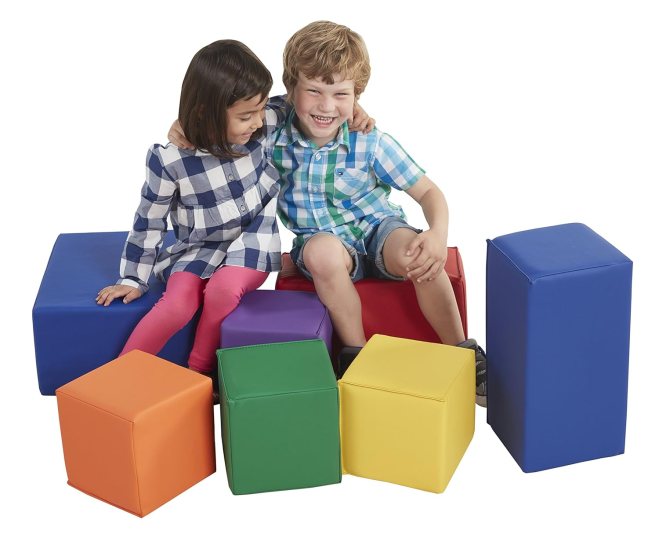
ECR4Kids SoftZone Foam Big Building Blocks – $79.99
http://amzn.com/004ZAITPO

We currently own one set of these foam building blocks. These are great for baby play, as older babies are able to stack the blocks into towers (that aren’t too heavy when they inevitably fall onto another baby), and younger babies are able to crawl onto these and sometimes pull themselves into a sitting or standing position using the blocks.

Just like the mats, these wipe clean easily.

Milliard Soft Foam Toddler Stairs and Ramp Climber Gym Toy – $72.99
http://amzn.com/B0788XVB6G

The exact ramp and stair set that we currently use isn’t available, but this set is very similar and would be a great addition to a set of soft climbing equipment. Our ramp and stair set is much more popular than the building blocks, as babies immediately see the stairs as a crawling or walking challenge. Our ramp has often turned into the setting of various science experiments with babies rolling balls and wheeled vehicles down its smooth surface.

Based on the description, this set also has a bottom strip that allows you to connect the stairs to the ramp. Our set does not have that option, and we have always used them as two pieces (though often positioned them like in the above picture).

These can also be wiped clean.

Conversation Starters

Start conversations as babies play with this tool by asking questions like:

  • What can you build with the blocks?
  • Can you walk up the steps?
  • How far can you throw the block?
  • Can you stand on top of the ramp?
  • How fast can you make a tower?

Stretch Vocabulary

When talking with little ones, use big words and small words. The more new words a child hears, the larger their vocabulary will be when they start to learn to read.

Consider using some of the following vocabulary words when using this activity:

Above
Balance
Behind
Big
Climb
Down

In Front
Jump
Giant
Over
Ramp
Short

Slide
Slope
Slow
Small
Towering
Up

Imagination Station: Movie Theater

Westerville Library’s youth department includes a pretend play area–our Imagination Station. Each month, a different youth librarian picks a theme and plans a play area designed for ages 3-6.

There are no strict guidelines for this space, but generally we try to:

  • Pick a theme that appeals to children
  • Keep all activities safe for all ages
  • Make clean-up and maintenance manageable for staff
  • Create materials and activities that are durable
  • Incorporate early literacy activities

In August 2018, I took over the Imagination Station, creating a play space I had been looking forward to for over a year: a movie theater.

Explore another Imagination Station – Mission Control themed – in this post.

Pretend Play: Movie Theater

While some of my Imagination Stations include a ton of obvious early literacy activities, this one focused almost entirely on pretend play. This appealed to all ages, with evening staff occasionally having to distract our older teens from playing at the Imagination Station so some of the younger toddlers could still enjoy the space. Pretend play has a ton of benefits for all ages, including social-emotional skills, language development, vocabulary building, problem solving skills, and more.

To create the “movie theater” experience, my Imagination Station had a few key areas:

  • Ticket Booth
  • Concession Stand (with popcorn machine)
  • Movie Posters
  • Showtime Board

Ticket Booth

The ticket booth included our department cash register, stocked with fake money. There was also a bin of tickets with space for cashiers to write down the name of the movie and a “tear-off” side so the tickets could be redeemed to see a movie. We had 3D glasses too–you have to be prepared for those special (and more expensive) movie showings!

Concession Stand

The concession stand included all of the classic movie theater favorites including:

  • Nachos (yellow felt circles — purchased pre-cut from Etsy for less than $5)
  • “Cheese” cups (condiment cups with yellow circles hot glued to the bottom
  • Drink Cups
  • Candy (purchased at Dollar Tree, emptied of candy, stuffed with stuffing, and wrapped in packing tape)
  • Popcorn

The popcorn machine was the favorite item of our visitors, but the least favorite item of staff. The popcorn box was a Donatos pizza delivery box from a past lock-in (when we had 20+ pizzas delivered). Holes were cut in each side, and the largest three holes were covered in clear cellophane. Popcorn could be scooped out of the front.

The individual popcorn kernels were crumpled squares of roughly 2″ x 2″ tissue paper. The kids loved the texture and enjoyed unraveling and re-rolling popcorn kernels.

Staff did not enjoy the clean up. I am still apologizing for the popcorn of 2018.

Movie Posters

The movie posters were one of my personal favorite spaces in this Imagination Station. Our awesome marketing department printed the larger “Coming Soon” and “Now Playing” signs on our library banner printer. I laminated those and attached 11″ x 17″ page protectors with a ton of packing tape, leaving the top of the sleeve open.

I printed about 20 kids movie posters that were a little smaller than the sleeves (so that pages dropped in easily). Kids loved swapping the posters out to show what was playing in their theater.

Showtime Board

The last element of my Imagination Station was the “Showtimes” board. This included a collection of showtimes and movie titles (that matched the names on the movie posters) that kids could swap out on our department magnet board.

I love creating these pretend play areas, but this theme was definitely one of my favorites. The kids loved it, asking where the popcorn went months later.

One of my favorite stories was when a child took her dad into our homework help center (during the early afternoon, when it wasn’t in use), turned off the lights, and started the movie, which they “watched” together while eating popcorn in the dark space. Pretend play for the win!

Baby Play: Taped Toys

After each of my baby storytimes, I include a Discovery Time free-play session that encourages parents to talk to one another and to interact with their children. I include a variety of fine motor, gross motor, and sensory activities that appeal to 0-2-year-olds.

Babies love a challenge. Making their regular favorite items just the smallest amount harder to access can be just enough to serve as an interesting distraction and build strong finger muscles needed for writing when they are older.

Taped toys are a very simple (and very cheap) project that just requires a little time ahead of a storytime to prepare. Use masking tape to tape baby-safe toys or household items to a hard surface. Favorite toys, instruments used in storytime, or bright, colorful items help make this a more appealing activity.

How to Make Taped Toys

Materials: hard surface (preferably not going to peel when tape is pulled off), masking tape, baby-safe toys or household objects

Steps:

  • Tape toys to hard surface. Use one long strip of tape per toy (more if working with older kids).

Cost: $0-5

  • Masking Tape
  • Hard Surface (Cardboard, Tri-Fold Board, Magnet Board, etc.)

Time to Make: 10 minutes

Pro-Tip: While cardboard is normally much easier to access, our department magnet/dry erase board, that we use for outreach, doesn’t show the damage of having masking tape peeled off repeatedly.

Conversation Starters

Start conversations as babies play with this tool by asking questions like:

  • What toys do you see?
  • What color is that toy?
  • How can you get the toy off the board?
  • What does the tape feel like?
  • Does the toy make a sound?
  • What does the toy fee like?

Stretch Vocabulary

When talking with little ones, use big words and small words. The more new words a child hears, the larger their vocabulary will be when they start to learn to read.

Consider using some of the following vocabulary words when using this activity:

Adhesive
Crumple
Flexible
Hard
Jerk
Lift

Pick
Poke
Pry
Pull
Remove
Reuse

Rip
Soft
Sticky
Stuck
Thin
Tug

Baby Play: Pipe Cleaner Colander Hats

After each of my baby storytimes, I include a Discovery Time free-play session that encourages parents to talk to one another and to interact with their children. I include a variety of fine motor, gross motor, and sensory activities that appeal to 0-2-year-olds.

Babies are naturally curious about the world around them. Pipe cleaners are a fascinating tool that has an interesting texture and can be bent into a variety of shapes. The holes in a standard kitchen colander are large enough for a pipe cleaner to be woven through with nimble finger muscles.

These colander sculptures very quickly turn into awesome pipe cleaner colander hats. The littlest babies enjoy putting the plain colander on their (and their adult’s) head; the older ones like making all kinds of fascinating creations by weaving the pipe cleaners into the tiny holes.

How to Make Pipe Cleaner Colander Hats

Materials: colanders, pipe cleaners

Steps:

  • Make one sample.
  • Put out collection of pipe cleaners and colanders.

Cost: $10+ (cost depends on audience size)

  • Colanders (Dollar Tree)
  • Pipe Cleaners (packs at Dollar Tree or Walmart)

Time to Make: < 5 minutes

Pro-Tip: I typically make a sample of this particular activity to help parents understand the goal, especially is this is one of a collection of activities. Otherwise I end up with a lot of confused faces (and colander hats–there are always colander hats).

Conversation Starters

Start conversations as babies play with this tool by asking questions like:

  • What do the pipe cleaners feel like?
  • What direction are you pulling that pipe cleaner?
  • What color should we add next?
  • What did you make? Is that a hat? A porcupine?
  • Can you find a purple pipe cleaner?
  • Can you twist two pipe cleaners together?
  • Can you make the pipe cleaner into a happy face?

Stretch Vocabulary

When talking with little ones, use big words and small words. The more new words a child hears, the larger their vocabulary will be when they start to learn to read.

Consider using some of the following vocabulary words when using this activity:

Around
Behind
Bend
Between
Colander
Curl

Knot
Over
Poke
Prickly
Sharp
Straight

Strainer
Thread
Through
Tug
Under
Wrap

It’s Monday! What Are You Reading?

We are joining the blog trend of Monday posts about what we have read during the last week (9/2/19-9/8/19).

Annamarie’s Reading

Annamarie’s top titles include:

I also enjoyed a few new adult titles while on vacation (I love adult historical romance when I have time for it).

Note: Annamarie serves as chair of the ALSC Notable Children’s Recordings Committee. Due to her position, she listens to and evaluates many audiobooks for children and teens. Annamarie never includes any of the audiobooks she listens to in her “What Are You Reading?” posts.

Michala’s Reading

Michala’s top titles include:

Note: Welcome back Annamarie! Also, I re-read Deadendia: The Watcher’s Test by Hamish Steele for my book club.

Pokemon Party

There is nothing quite like the Pokemon fandom. Pokemon love spans all ages–from preschoolers to grown-ups. There is a huge Pokemon following at my library, and this year’s Pokemon Party was no exception, with 150 folks coming together to celebrate.

My unregistered fandom programs over the summer typically include three core elements: group trivia, group BINGO, and a variety of crafts and games that folks can participate in at anytime. The annual Pokemon Party involves a few additional items, including raffle/door prizes as well as a ton of snacks. I normally avoid food in programs, but at each Pokemon event, I have groups of kids who bring binders of trading cards and sit with other kids for the entire two hours. The snacks are meant for them but are available for everyone.

Looking for More Pokemon?

Check out how I made this program virtual with Pokémon Trivia, Pokémon BINGO, and Guess that Pokémon.

Pokemon Trivia & BINGO

Trivia and BINGO are optional for whoever wants to participate. Trivia is difficult intentionally, with prizes for the Pokemon trivia experts. Everyone who participates gets a sticker, but our top three trivia masters get to pick from some nicer themed prizes (in order from highest to lowest score).

The program outline and all trivia questions are in the below powerpoint. Download here.

BINGO is for everyone. We continue to play until everyone has gotten a BINGO. For many of our youngest players, this is their first ever BINGO game! When someone gets a BINGO, they bring their board to the front of the room and get to reach into a mystery bag filled with tiny Pokemon figurines. One prize-winning BINGO per person.

I got my BINGO boards free from The Eco Friendly Family, and using the extra boards provided, created enough boards to have 50 players at once.

3Doodlers & Button Makers

I use our library tech whenever possible, especially at fandom party programs. The 3Doodler pens made an appearance, with outlines of various Pokemon to trace (Pikachu was the favorite).

Our 2.25″ button maker was also available, with a teen volunteer helping kids make as many buttons as they would like.

Pokeball Ping Pong Balls

This is my third Pokemon event, and I am always on the hunt for new crafts. One of this year’s addition was ping pong balls with sharpies and pictures of Pokeballs. Kids could color their own Pokeballs, with clear rules that they couldn’t throw their new pokeballs during the program.

Trainer Toolbelts

Another new craft for this year was trainer toolbelts. I gave kids black strips of 12″x18″ paper, string to tie to the ends, and various cardstock pokeball designs they could color and cut out. “Pokeballs” could be taped or glued onto “pokebelts” and worn around the waist.

Guess the Pokemon

Guess the Pokemon is an annual favorite game. This year, I used 20 new Pokemon silhouettes. Kids had to identify the Pokemon’s name, check their answers, and pick up a small prize.

Pin the Tail on Pikachu

Exactly what it sounds like. Kids pinned the tail on Pikachu. This was also a return game from past events.

Catch the Pokemon

I wrapped pop cans in Pokemon character faces and colors. Kids threw a stuffed pokeball at the cans in an effort to “catch” the Pokemon by knocking the cans down.

Pokemon Scavenger Hunt

Each year, to advertise my Pokemon Party, I put a Pokemon scavenger hunt around the youth department, adapted from the one created by the Ontarian Librarian. This is always a huge hit, with a few hundred kids completing the scavenger hunt.

Baby Play: Texture Tiles

After each of my baby storytimes, I include a Discovery Time free-play session that encourages parents to talk to one another and to interact with their children. I include a variety of fine motor, gross motor, and sensory activities that appeal to 0-2-year-olds.

Texture tiles have been a big hit at my storytimes (though not quite as successful as my coworker’s liquid sensory tiles–more on those in another few weeks). Various textured items are hot glued, zip tied, or otherwise secured to foam puzzle tiles.

I put these out in a big stack, and the kids decide whether they want to interact with individual tiles or if they want to connect different tiles together.

Textures can include:

  • Sandpaper
  • Cardboard
  • Bubble Wrap
  • Felt
  • Foam
  • Carpet Square
  • Craft Sticks
  • Thin Wood
  • Pom Poms
  • Googly Eyes
  • Fur
  • Memory Foam
  • Pipe Cleaners
  • Rocks/Moss
    • I found circular, pre-made thin “stepping stones” at Michaels a few years ago. The rocks seem to be permanently fixed to the thin sheet, as I’ve never had one break off. I can’t find a similar item online at the moment–if you know of something like this, please share in the comments below.

How to Make Texture Tiles

Materials: 12″ x 12″ foam puzzle tiles, various sensory surfaces (I used what was on hand), hot glue

Steps:

  • Decide how many tiles you are going to make.
  • Cut textures to smaller than the size of the tiles (about 10″ x 10″)
  • Hot glue to attach textures to tiles (or use other adhesives as necessary).
  • After glue has dried, thoroughly test all surfaces to make sure items are stuck to the tiles.

Cost: $25+

Time to Make: 30 minutes

Pro-Tip: Make sure to check these tiles after each use, especially if you plan to attach smaller items (pom poms, googly eyes, rocks, etc.). After many weeks of using these, I have a fairly good idea which tiles will need reinforced.

Conversation Starters

Start conversations as babies play with this tool by asking questions like:

  • How does that surface feel?
  • Which texture do you like best—the bumpy one or the squishy one?
  • Can you hop on the soft part?
  • Can you walk very slowly?
  • What happens when you step on that surface?
  • What color is that texture?

Stretch Vocabulary

When talking with little ones, use big words and small words. The more new words a child hears, the larger their vocabulary will be when they start to learn to read.

Consider using some of the following vocabulary words when using this activity:

Bumpy
Comfortable
Fast
Fluffy
Hard
Hop

Jump
Lumpy
Mushy
Prickly
Rough
Slow

Soft
Spongy
Squishy
Surface
Texture
Uneven