After each of my baby storytimes, I include a Discovery Time free-play session that encourages parents to talk to one another and to interact with their children. I include a variety of fine motor, gross motor, and sensory activities that appeal to 0-2-year-olds.
Babies are naturally curious about the world around them. Pipe cleaners are a fascinating tool that has an interesting texture and can be bent into a variety of shapes. The holes in a standard kitchen colander are large enough for a pipe cleaner to be woven through with nimble finger muscles.
These colander sculptures very quickly turn into awesome pipe cleaner colander hats. The littlest babies enjoy putting the plain colander on their (and their adult’s) head; the older ones like making all kinds of fascinating creations by weaving the pipe cleaners into the tiny holes.
How to Make Pipe Cleaner Colander Hats
Materials: colanders, pipe cleaners
Steps:
Make one sample.
Put out collection of pipe cleaners and colanders.
Cost: $10+ (cost depends on audience size)
Colanders (Dollar Tree)
Pipe Cleaners (packs at Dollar Tree or Walmart)
Time to Make: < 5 minutes
Pro-Tip: I typically make a sample of this particular activity to help parents understand the goal, especially is this is one of a collection of activities. Otherwise I end up with a lot of confused faces (and colander hats–there are always colander hats).
Conversation Starters
Start conversations as babies play with this tool by asking questions like:
What do the pipe cleaners feel like?
What direction are you pulling that pipe cleaner?
What color should we add next?
What did you make? Is that a hat? A porcupine?
Can you find a purple pipe cleaner?
Can you twist two pipe cleaners together?
Can you make the pipe cleaner into a happy face?
Stretch Vocabulary
When talking with little ones, use big words and small words. The more new words a child hears, the larger their vocabulary will be when they start to learn to read.
Consider using some of the following vocabulary words when using this activity:
I also enjoyed a few new adult titles while on vacation (I love adult historical romance when I have time for it).
Note: Annamarie serves as chair of the ALSC Notable Children’s Recordings Committee. Due to her position, she listens to and evaluates many audiobooks for children and teens. Annamarie never includes any of the audiobooks she listens to in her “What Are You Reading?” posts.
There is nothing quite like the Pokemon fandom. Pokemon love spans all ages–from preschoolers to grown-ups. There is a huge Pokemon following at my library, and this year’s Pokemon Party was no exception, with 150 folks coming together to celebrate.
My unregistered fandom programs over the summer typically include three core elements: group trivia, group BINGO, and a variety of crafts and games that folks can participate in at anytime. The annual Pokemon Party involves a few additional items, including raffle/door prizes as well as a ton of snacks. I normally avoid food in programs, but at each Pokemon event, I have groups of kids who bring binders of trading cards and sit with other kids for the entire two hours. The snacks are meant for them but are available for everyone.
Trivia and BINGO are optional for whoever wants to participate. Trivia is difficult intentionally, with prizes for the Pokemon trivia experts. Everyone who participates gets a sticker, but our top three trivia masters get to pick from some nicer themed prizes (in order from highest to lowest score).
The program outline and all trivia questions are in the below powerpoint. Download here.
BINGO is for everyone. We continue to play until everyone has gotten a BINGO. For many of our youngest players, this is their first ever BINGO game! When someone gets a BINGO, they bring their board to the front of the room and get to reach into a mystery bag filled with tiny Pokemon figurines. One prize-winning BINGO per person.
I got my BINGO boards free from The Eco Friendly Family, and using the extra boards provided, created enough boards to have 50 players at once.
3Doodlers & Button Makers
I use our library tech whenever possible, especially at fandom party programs. The 3Doodler pens made an appearance, with outlines of various Pokemon to trace (Pikachu was the favorite).
Our 2.25″ button maker was also available, with a teen volunteer helping kids make as many buttons as they would like.
Pokeball Ping Pong Balls
This is my third Pokemon event, and I am always on the hunt for new crafts. One of this year’s addition was ping pong balls with sharpies and pictures of Pokeballs. Kids could color their own Pokeballs, with clear rules that they couldn’t throw their new pokeballs during the program.
Trainer Toolbelts
Another new craft for this year was trainer toolbelts. I gave kids black strips of 12″x18″ paper, string to tie to the ends, and various cardstock pokeball designs they could color and cut out. “Pokeballs” could be taped or glued onto “pokebelts” and worn around the waist.
Guess the Pokemon
Guess the Pokemon is an annual favorite game. This year, I used 20 new Pokemon silhouettes. Kids had to identify the Pokemon’s name, check their answers, and pick up a small prize.
Pin the Tail on Pikachu
Exactly what it sounds like. Kids pinned the tail on Pikachu. This was also a return game from past events.
Catch the Pokemon
I wrapped pop cans in Pokemon character faces and colors. Kids threw a stuffed pokeball at the cans in an effort to “catch” the Pokemon by knocking the cans down.
Pokemon Scavenger Hunt
Each year, to advertise my Pokemon Party, I put a Pokemon scavenger hunt around the youth department, adapted from the one created by the Ontarian Librarian. This is always a huge hit, with a few hundred kids completing the scavenger hunt.
After each of my baby storytimes, I include a Discovery Time free-play session that encourages parents to talk to one another and to interact with their children. I include a variety of fine motor, gross motor, and sensory activities that appeal to 0-2-year-olds.
Texture tiles have been a big hit at my storytimes (though not quite as successful as my coworker’s liquid sensory tiles–more on those in another few weeks). Various textured items are hot glued, zip tied, or otherwise secured to foam puzzle tiles.
I put these out in a big stack, and the kids decide whether they want to interact with individual tiles or if they want to connect different tiles together.
Textures can include:
Sandpaper
Cardboard
Bubble Wrap
Felt
Foam
Carpet Square
Craft Sticks
Thin Wood
Pom Poms
Googly Eyes
Fur
Memory Foam
Pipe Cleaners
Rocks/Moss
I found circular, pre-made thin “stepping stones” at Michaels a few years ago. The rocks seem to be permanently fixed to the thin sheet, as I’ve never had one break off. I can’t find a similar item online at the moment–if you know of something like this, please share in the comments below.
How to Make Texture Tiles
Materials: 12″ x 12″ foam puzzle tiles, various sensory surfaces (I used what was on hand), hot glue
Steps:
Decide how many tiles you are going to make.
Cut textures to smaller than the size of the tiles (about 10″ x 10″)
Hot glue to attach textures to tiles (or use other adhesives as necessary).
After glue has dried, thoroughly test all surfaces to make sure items are stuck to the tiles.
Pro-Tip: Make sure to check these tiles after each use, especially if you plan to attach smaller items (pom poms, googly eyes, rocks, etc.). After many weeks of using these, I have a fairly good idea which tiles will need reinforced.
Conversation Starters
Start conversations as babies play with this tool by asking questions like:
How does that surface feel?
Which texture do you like best—the bumpy one or the squishy one?
Can you hop on the soft part?
Can you walk very slowly?
What happens when you step on that surface?
What color is that texture?
Stretch Vocabulary
When talking with little ones, use big words and small words. The more new words a child hears, the larger their vocabulary will be when they start to learn to read.
Consider using some of the following vocabulary words when using this activity:
Pumpkinheads by Rainbow Rowell and Faith Erin Hicks
Note: I am not gallivanting all over and having vacation adventures over the next couple of weeks. So, I tried to pack in a few more picture books and middle grade books to help fill the big void of no Annamarie picks.
After receiving a grant for some technology items two years ago, I’ve been running registered, monthly technology programs for upper elementary school kids (roughly ages 8-12).
These were great programs, except for a few recurring issues:
Each program focuses on one topic or device, and I have a limited number of devices, so a limited number of kids could attend (max. of 20, sometimes as few as 10).
This means that these programs had to be registered. Registration often filled up within 30 minutes of it opening (two weeks before the program date), even when I was offering 2-4 sessions in a month.
Each program, I have a new set of kids with different abilities. Some have coding skills well beyond my own; others have never heard the word “coding” before walking through the door. This made it hard to plan anything too advanced.
While programs were designed for ages 8-12, I often have parents sign up their 5-7-year-olds for my programs. While I am glad they are excited about tech, it makes it even more difficult to teach basic coding to a group of kids with mixed abilities when a few of them can’t even read yet.
This summer, I decided to try something different. Instead of offering weekly registered tech programming, I offered a monthly tech fair. I put out as much technology as could fit in our space and work with the number of tablets we own. I wasn’t sure what to expect with attendance or participation, but overall the programs were a success.
Find more examples of Innovation Academy programs in these posts:
During each month’s tech fair, I strategically planned out how the room was laid out to accommodate the most technology. Almost all of the technology we own was used at some point during the summer–it was a great bonus to see everything out of the cabinets and being used by the public.
Tech I used at least once over the three programs included:
Each technology item was at a different station with a loosely structured activity. As the sessions went on, I realized that structured activities really weren’t necessary. Kids explored the technology in deeper and more creative ways when they had the time to do that on their own without having to focus on specific steps in a task.
Family Engagement
An unexpected outcome of this program was the multi-generational experiences and learning that took place. During my monthly registered tech programs, sibling partners often worked together, but, with rare exceptions, adults stayed outside of the room.
Since the tech fair wasn’t structured in the same way, adults were welcomed into the tech space. Little siblings came too. Third graders showed grandparents how to build a video game with Bloxels. Parents explained to kids how Ozobots use sensors to read color patterns that tell them to complete certain actions. Five-year-olds who didn’t yet have the skills to use the Blocky app with Dash helped create an obstacle course, and an older sibling explained to them how their code worked.
Families walked out of the program with some hands on time with new technology after thinking creatively about ways to take a simple challenge or activity to a new level.
Tech fairs are simpler for me to plan than monthly programs. I am essentially pulling from our supply of tech, charging and pairing everything, and leaving the rest up to our patrons. Registration and age requirements are no longer issues. However, the simplicity in program planning is not why I want to repeat this series–the learning that came from family engagement made this series something to remember.
This coming weekend Cartoon Network is showing every single Steven Universe episode ever, all leading up to the premiere of the new Steven Universe musical on Monday…so this feels like a great time to talk about my Steven Universe Color Party program!
Steven Universe and the Crystal Gems (Pearl, Amethyst and Garnet).(Cartoon Network)
If you are unfamiliar with the TV show Steven Universe let me try and catch you up to speed, even though I will not be able to do the show justice at all. Let me start by saying that it is the most LGBQT+ cartoon you will ever watch, it is political, diverse, and even though the entire premise revolves around alien gem lifeforms with special fighting powers it is completely relatable.
The first season features a goofy kid named Steven and weird alien adventures that he goes on with his female warrior guardians, the Crystal Gems. Steven is learning to master his alien gem powers as he is half human and half gem. His lovable human dad is a bit of an oaf and the other unique and diverse characters in Beach City are all given decently explored back stories which we learn throughout the seasons.
Then season two drops and you get more back story on the Gems and you begin to think wow there is more to this show than just a fun alien saving rainbow world….then seasons three through five having you question how you were lulled into thinking this was anything but an epicly awesome, equality driven ode to love, diversity, rainbows, and truth.
Steven Universe shows human nature better than any TV show I have ever seen. It may be geared for kids, tweens, and teens, but it does not shy away from big issues or dumb down it’s content. It walks the line of having pop culture appeal and being topically relevant to society which is why I think so many of my kids gravitate towards it. And is why this summer we needed to have a fun, light hearted party to celebrate the alien space gem warriors.
I planned stations and activities based upon the Crystal Gems’s strengths where each attendee got to go through different “training” with each Gem and of course it had to be very colorful.
Pearl
Pearl is the mom figure of the group. She is always looking out for Steven’s best interest and trying to guide him through life. While she is a stickler for rules, Pearl understands that Steven learns in his own way and helps teach him skills he needs as a Crystal Gem, like bubbling.
(Cartoon Network)
For Pearl’s station we worked on our bubbling skills. I added various food coloring colors to bubble mix and had teens blow bubbles using the colored mixture at white paper. You can also place bubble mix in cups and use a straw to blow bubbles in the cup until the mixture overflows for more intense bubble shadows.
Garnet is actully a gem fusion. She is the combination of Ruby and Sapphire. So for her station teens got to play with my giant spin art machine* and fuse colors together.
Amethyst
Amethyst is a bit of a rebel in the group. She is the gem that pushes boundaries and speaks her mind bluntly. Amethyst also has a fun kid like streak to her perosnality. Since everything is very straight forward, upfront and fun with Amethyst we needed an activity that fit that criteria.
So instead of Steven Tag we played Rainbow Tag!
Rainbow tag is exactly like regular tag only all players are running around with handfuls of color run or Holi Festival powder*. The regular rules of the game still apply, but with a twist. One person is it and will chase other players in a designated area trying to tag someone, if they succeed the tagged individual becomes the next person that is it and the cycle continues. The twist is that instead of tagging someone by tapping them with a hand, Rainbow Tag lets you tag someone by throwing your handful of color powder at another player. The game ends when you run out of powders or out of energy to run around, whichever comes first.
Peridot & Lapis Lazuli
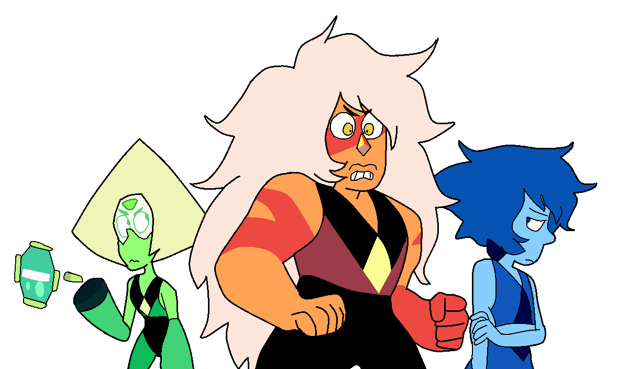
Peridot and Lapis Lazuli are newer members of the Crystal Gems. (Another member of the squad that could have been included in this activity is Jasper, but I had to cut her out of this area as my printer decided it was no longer going to print properly and was unable to have her repped during the program.) Peridot was a mathematical Home World Gem that was converted to the ideas of the Crystal Gems and began to fight to save humanity. Lapis Lazuli is a water based Gem that had been fractured during the first Gem War and was bubbled for safety reasons until freed by Steven. (The militant, Jasper was also a Home World Gem and had a longer redemption arc before joining the Crystal Gems.
Lapis Jasper Peridot sketch By Peri.png
This final station was all about accuracy, power, and water, which could only mean…..water balloons! Teens got to aim and throw water balloons filled with colored water at targets to improve their Crystal Gem fighting skills.
All in all we had an awesome time and there was a lot of very heated discussions about Crystal Gems and their character flaws while having fun with art!
*Giant spin art machine and DIY color run powder directions will be featured in next week’s blog post
After each of my baby storytimes, I include a Discovery Time free-play session that encourages parents to talk to one another and to interact with their children. I include a variety of fine motor, gross motor, and sensory activities that appeal to 0-2-year-olds.
I’ve been interested in creating a large pom pom drop for a while, and I finally had the opportunity when a coworker donated over 20 empty Pringles cans to the youth department. Walking babies and toddlers particularly enjoyed grasping the 2″ pom poms and watching them fall through the colorful tubes.
In addition to developing those ever-important fine motor skills, little ones learned about cause and effect as they dropped pom poms through different tubes at different heights.
How to Make a Pom Pom Drop
Materials: hard backing material (we used leftover insulation board from a previous project), empty Pringles cans, construction paper, hot glue, packing tape, sharp kitchen knife, 2″ pom poms
Steps:
Enforce edges of backing material as needed to make sure nothing is sharp or peeling.
Use sharp, large kitchen knife to cut empty Pringles cans to a variety of lengths. At a minimum, the knife works great to cut an inch or so above the metal bottom of the can, removing all of the sharp bits in one cut. (There are tutorials online about using a can opener for this process, but I could never get it to work cleanly without something sharp being left behind.)
Measure your cut can’s length. Cut a piece of construction paper to the same length.
Optional: Laminate the construction paper for extra durability.
Wrap the construction paper around the can and tape it on securely.
Hot glue construction-paper-wrapped cans to the backing materials.
As needed, further secure each can by wrapping packing tape around the front to secure it to the board.
Cost: $20+ (cost depends on backing material and number of pom poms)
Backing Material (use what you have on hand, we used insulation board like this)
Pro-Tip: Ball pit balls also fit through Pringles cans! If you have limited resources, ball pit balls have many uses and are easier to clean than pom poms.
Conversation Starters
Start conversations as babies play with this tool by asking questions like:
Can you drop the pom pom in a tube?
What happens when the pom pom goes into a tube?
What color is the pom pom?
How does the pom pom feel?
What happens if the tube is at an angle?
How many pom poms can you drop through the tubes?
Can you catch a falling pom pom?
Stretch Vocabulary
When talking with little ones, use big words and small words. The more new words a child hears, the larger their vocabulary will be when they start to learn to read.
Consider using some of the following vocabulary words when using this activity:
Note: I am not gallivanting all over and having vacation adventures over the next couple of weeks. So, I tried to pack in a few more picture books and middle grade books to help fill the big void of no Annamarie picks.
Mother Bruce is one of my favorite book characters. If you haven’t read, or, even better, listened to, the book Mother Bruce by Ryan T. Higgins, track down a copy now. It is a funny read, perfect for preschool through first or second grade. The audiobook, read by Roberston Dean, is a particular favorite of mine with excellent pacing, great sound effects, and an original musical score that brings the grumpy old bear to life.
I was determined to celebrate one of my favorite storytime characters at the library. We had a great Saturday morning with a family storytime and a visit from Bruce himself!
After storytime, folks were welcome to participate in a variety of themed activities. These included:
Mother Bruce Ears & Gosling Craft
Visitors cut out bear ears and attached them to brown headbands. Optionally, they could also cut out yellow goslings to tape to a string hanging off the back of their headband (so your goslings would follow you everywhere, just like Bruce’s). Download here.
Goin’ On a Bear Hunt Obstacle Course
No preschool program is complete without some physical fun. Little ones explored our Goin’ On a Bear Hunt obstacle course. They completed some of the activities we did as a group during storytime including climbing a mountain, crossing a river, walking through a wheat field, and going into a cave to find our bear puppet.
Find the Goslings Scavenger Hunt
Ten goslings were hidden around our meeting room, and little ones had to find them all! When they found all ten geese, they got to pick a Mother Bruce bookmark. Download the scavenger hunt sheet here.
Download geese to hide around your room or library here.
Gosling Match
I love to give little ones an opportunity to play in water. Just like a fair game, little ones could pick up rubber “goslings” and try to find two with matching colored bottoms.
This didn’t work quite as planned, as my ducks shifted and didn’t want to stay bottoms down in the water.
Meet Bruce!
The star of the event–Bruce came to visit! After sufficient warning to prepare little ones for a visit from the big bear, Bruce stopped by for photos and to participate in the crafts and activities. The Costume Specialist store in Columbus, Ohio lets libraries borrow book character costumes for free, and these visits always make an exciting addition to any program.