After each of my baby storytimes, I include a Discovery Time free-play session that encourages parents to talk to one another and to interact with their children. I include a variety of fine motor, gross motor, and sensory activities that appeal to 0-2-year-olds.
Once a baby’s vision develops, they love to look at faces, including their own. Starting around nine months of age, babies will begin to recognize their own reflection in a mirror. A great way to test this is to put a sticker on a mirror. If the baby tries to wipe their own face after looking in the mirror and seeing the sticker, they recognize that they are seeing themselves and not looking at a picture.
Baby-safe mirrors provide fantastic ways for parents and little ones to interact, from adults copying little one’s facial expressions to working together to identify basic body parts. With large mirrors, babies can sit in front of them while a parent moves an object behind the baby, helping the baby practice visual tracking with their eyes.
We currently don’t have enough mirrors to use these as storytime manipulatives, but I do put out our small collection during baby play time for mirror play. While mirrors are not as large as some of our other toys, babies are still fascinated by them, particularly once they catch a glimpse of their own reflection.
Consider your audience size when determining how many mirrors you want to purchase, especially if you are also using these as manipulatives in storytimes. There are many fantastic mirror rhymes for during storytimes.
Personally, I prefer mirrors that do not have to be affixed to a wall, as these can easily be packed up after baby play, eliminating a distraction during storytimes and programs for older children.
Conversation Starters
Start conversations as babies play with this tool by asking questions like:
What do you see in the mirror?
Can you find your eyes in the mirror?
What does the toy look like in the mirror?
What happens when the light bounces off the mirror?
Stretch Vocabulary
When talking with little ones, use big words and small words. The more new words a child hears, the larger their vocabulary will be when they start to learn to read.
Consider using some of the following vocabulary words when using this activity:
After each of my baby storytimes, I include a Discovery Time free-play session that encourages parents to talk to one another and to interact with their children. I include a variety of fine motor, gross motor, and sensory activities that appeal to 0-2-year-olds.
Scarves are a staple in many baby storytimes. They are an ideal item for parents and children to manipulate together. Scarves are particularly fantastic for games of peek-a-boo, teaching basic object permanence to our youngest learners. Babies can grip scarves, even from the youngest ages, and most enjoy placing them on various body parts or just shaking them vigorously.
Scarves are also fantastic free-play items. The easiest way to make scarves accessible to little ones is by hiding or placing them in a container that little ones have to pull scarves out of.
I regularly use two kinds of items to hold scarves during play–Oballs and empty tissue boxes. Both storage containers allow little ones to practice fine motor skills in an effort to pull the scarf out. Generally, tissue boxes are a much easier tool for pulling than oballs (and cheaper). However, oballs pose a better challenge for older babies and toddlers.
Both storage items, though particularly tissue boxes, also allow babies and toddlers to learn about case and effect. When they reach inside a box and pull, something interesting comes out!
Of course, once the scarves are out of the box (or ball), they can be used for all kinds of play. The little one below ended up with a cape of scarves this past summer.
Consider your audience size when determining how many scarves you want to purchase, especially if you are also using these as manipulatives in storytimes.
For play, a rectangular tissue box can hold 5-10 scarves. An oball can nicely fit 3-4 scarves.
Pro Tip: Scarf prices at Lakeshore Learning don’t fluctuate much (though look out for coupons). Oball prices on Amazon change often. You should be able to buy each oball for $4-5 each. If they cost drastically more (I’ve seen them up to $20 each!), keep checking back daily until prices drop again.
Conversation Starters
Start conversations as babies play with this tool by asking questions like:
Can you pull the scarf out of the oball?
How does the scarf feel? How does the ball feel?
Can you put the scarf on your head?
What color is the scarf?
How fast can you wave your scarf?
Can you play peek-a-boo with your scarf?
Stretch Vocabulary
When talking with little ones, use big words and small words. The more new words a child hears, the larger their vocabulary will be when they start to learn to read.
Consider using some of the following vocabulary words when using this activity:
After each of my baby storytimes, I include a Discovery Time free-play session that encourages parents to talk to one another and to interact with their children. I include a variety of fine motor, gross motor, and sensory activities that appeal to 0-2-year-olds.
Babies love a challenge. Making their regular favorite items just the smallest amount harder to access can be just enough to serve as an interesting distraction and build strong finger muscles needed for writing when they are older.
Spider web baskets are a very simple project that just requires a little time ahead of a storytime to prepare. Find a stash of baskets that have holes along the sides–the ones pictured here are more standard, sturdier laundry baskets from Walmart, but there are many baskets of this style at Dollar Tree. Toss favorite toys, instruments used in storytime, or bright, colorful items onto the bottom, and tie a web of strings across the top. Fewer strings in simpler designs for smaller babies, and more complicated creations for older kids.
How to Make Spider Web Baskets
Materials: laundry basket, yarn, baby-safe toys or household objects
Steps:
Place toys or objects in the bottom of the basket (this can be done after the next step instead).
Tie string across the basket in various patterns, at least 5-6 strings for a very simple challenge.
Cost: $0-10
Baskets (can be bought at Dollar Tree, though sturdier laundry baskets can be found at Walmart for less than $10)
Yarn
Time to Make: 10 minutes
Pro-Tip: Make sure to double knot the string to the basket so that it is less likely to come undone and be a potential hazard for little ones.
Conversation Starters
Start conversations as babies play with this tool by asking questions like:
What toys can you reach?
How can you get the dog out of the basket?
What toy did you find?
What color is the toy?
What can you do with the toy?
Are any toys stuck?
What do the strings feel like?
Stretch Vocabulary
When talking with little ones, use big words and small words. The more new words a child hears, the larger their vocabulary will be when they start to learn to read.
Consider using some of the following vocabulary words when using this activity:
After each of my baby storytimes, I include a Discovery Time free-play session that encourages parents to talk to one another and to interact with their children. I include a variety of fine motor, gross motor, and sensory activities that appeal to 0-2-year-olds.
In most of my baby play posts, I talk about items that are easy and relatively cheap to replicate, often with items found around the house or at Dollar Tree. I love using play items like cereal boxes and straws and taped toys because they provide parents with ideas that they can easily recreate on their own and remind everyone that baby toys don’t have to be super expensive.
However, if a library has the budget, it can also be nice to provide some items that cost money too. For more affluent parents, you are providing them an opportunity to test out some baby items before making the decision to purchase something. For those families with less funds, you are giving their little ones an opportunity to interact with a type of toy they may not be able to experience at home.
One of my coworkers came across Squiqz when visiting family. These “fun little suckers” (the actual slogan) are essentially flexible, brightly colored building tools with suction cups. A standard collection comes with eight different designs, most of which involve at least two suction cups. They stick to each other and most surfaces, including windows, mirrors, and cookie sheets, never leaving a residue behind.
These tools are a fascinating texture for little hands (and mouths). Made of BPA-free, latex-free silicone, they easily survive the chewing that always takes place during baby play time. The smallest babies just love exploring their shapes with their hands and mouths. Slightly older babies (8-18 months) are developing the fine motor skills to be able to stick these individually to a flat surface and to pull them off afterwards (often more challenging). Older toddlers can start to build structures by sticking them together, as their finger muscles get stronger.
Start conversations as babies play with this tool by asking questions like:
What does it feel like?
What color is the Squig?
Can you make it stick to the window?
How many do you have?
What can you do to get the Squigz off the cookie sheet?
What happens if the Squigz get wet?
Stretch Vocabulary
When talking with little ones, use big words and small words. The more new words a child hears, the larger their vocabulary will be when they start to learn to read.
Consider using some of the following vocabulary words when using this activity:
After each of my baby storytimes, I include a Discovery Time free-play session that encourages parents to talk to one another and to interact with their children. I include a variety of fine motor, gross motor, and sensory activities that appeal to 0-2-year-olds.
The pool noodle abacus helps the littlest children practice fine motor skills and older toddlers and preschool practice basic math. While a true abacus requires more than two strings, this creates a similar effect for young learners, while also providing a cool activity to experiment with how the pool noodle pieces move back and forth and how much pressure the yarn can withstand.
I tied the string between two chairs, though I would suggest something more sturdy if you have that available. Many children moved the chairs or manged to remove one end of the string (the top piece was taped on instead of tied on). Also consider whether you want the string closer to a wall or further away–having the lower string further from the wall encouraged climbing between the strings. This can be a great way to practice gross motor skills, or it can also be seen as a tripping hazard.
How to Make A Pool Noodle Abacus
Materials: yarn, pool noodles, knife, scissors
Steps:
Use the knife to cut 1-2 pool noodles into roughly 1-3″ pieces.
Tie one end of a piece of thick yarn to a sturdy surface, like a chair.
String about 20 pool noodle pieces onto the string (or whatever amount fits in the space you have).
Cut the other end of the string, leaving at least 1-2 feet of empty string so pieces can be moved easily.
Securely tie the other end of the string to another sturdy surface.
Repeat for however many rows of strings you would like to create.
Cost: $0-5
2 Pool Noodles (Dollar Tree)
Yarn
Time to Make: 10 minutes
Pro-Tip: To expand this activity, try cutting a vertical slit in one side of a pool noodle piece so the pool noodle piece can also be removed from the string. Little ones can explore how to add or remove pool noodle pieces from the abacus.
Conversation Starters
Start conversations as babies play with this tool by asking questions like:
How many red pool noodle pieces are on the rope?
Can you find a blue pool noodle?
How many pool noodle pieces are on the rope total?
Can you push five pieces to one side of the rope?
How do the pool noodles feel?
Stretch Vocabulary
When talking with little ones, use big words and small words. The more new words a child hears, the larger their vocabulary will be when they start to learn to read.
Consider using some of the following vocabulary words when using this activity:
After each of my baby storytimes, I include a Discovery Time free-play session that encourages parents to talk to one another and to interact with their children. I include a variety of fine motor, gross motor, and sensory activities that appeal to 0-2-year-olds.
Similar to the cereal boxes and straws activity, the popularity of the card slot drop always surprises me. This very simple DIY activity involves cutting a card-sized hole into a container–in this case a bulk-sized Oatmeal container–and providing cards for babies to drop inside of the opening.
I have coworkers who regularly donate these cylindrical oatmeal containers, so they become a great, free resource for these kinds of activities. I particularly like how easy the lid is to remove. Parents can easily dump out the contents of a container if it gets full, and older toddlers can manage to open the container themselves, growing finger muscles and providing a sense of accomplishment.
Babies enjoy putting smaller objects into bins, but this activity is particularly beneficial because of the small card-sized hole in the lid. In addition to fine motor skills, it takes practiced dexterity and hand eye coordination for little ones to be able to fit the card into the slot.
How to Make a Card Slot Drop
Materials: pack of playing cards, empty oatmeal container (alternatively could be a box or other sturdy container on hand), duct tape, x-acto knife
Steps:
Use the knife to cut a slot in the lid of the oatmeal container (or box) that is about a 0.25″ x 3″ (wide enough for a playing card to fit through).
As necessary, cover any ripped or jagged edges with pieces of duct tape.
Put lid onto container.
Put out container and pack of opened playing cards.
Cost: $0-5
Playing Cards (Dollar Tree)
Empty Oatmeal Container or Box
Time to Make: 10 minutes
Pro-Tip: I’ve had more success cutting the slot into the lid of the oatmeal container while the lid was on the empty container. This may just be due to my lack of skills with cutting implements.
Conversation Starters
Start conversations as babies play with this tool by asking questions like:
Can you put the card inside the container?
How many cards can you fit in at one time?
What does the card feel like?
Shake the container. What does it sound like?
How can you get the cards back out?
Play pretend. What else could the playing cards be?
Stretch Vocabulary
When talking with little ones, use big words and small words. The more new words a child hears, the larger their vocabulary will be when they start to learn to read.
Consider using some of the following vocabulary words when using this activity:
After each of my baby storytimes, I include a Discovery Time free-play session that encourages parents to talk to one another and to interact with their children. I include a variety of fine motor, gross motor, and sensory activities that appeal to 0-2-year-olds.
While not the prettiest of my replicate-at-home baby play items, tugging boxes help little ones explore cause and effect (STEM) while also experiencing different textures (sensory play) and building fine motor skills by wrapping their fingers around small items and developing muscles by pulling.
I haven’t found the perfect combination to make these tugging boxes sturdy but physically attractive so that more little ones and parents gravitate toward them during playtime. I’ve considered wrapping the boxes, but I think the babies would then focus on trying to tear off the paper. If you have any ideas on making these more visually appealing, please comment below!
Overall, this is a great item that requires some time to make but no setup before storytime. I use a pencil to punch 3 holes in each side of the box and then weave various types of string, rope, lace, thick yarn, etc. from one side of the box to the other. After tying off both ends of the string (making a knot large enough so that the material cannot be pulled back into the box can be difficult), little ones can pull on one end of the string and see what happens to the other side of the string.
How to Make Tugging Boxes
Materials: empty box, pencil, various types of thick string/yarn/rope, shipping tape
Steps:
Poke 3 holes with a pencil in each side of an open, empty box.
Weave string or rope through two holes, so each end of a string comes out of a different side of the box. Tie large knots to each end of the rope so that neither end of the rope can re-enter the box when the other side is pulled on.
Repeat the second step until all holes have string or textured yarn in them.
Use shipping tape to secure box seams and to tape the box closed.
Cost: $0-10
Variety of thick yarns, ropes, lace, etc.
Time to Make: 15 minutes
Pro-Tip: Consider using a tool smaller than a pencil to poke the hole in the box. Also, it may be valuable to tape the yarn or rope you are trying to weave through the box holes to a paperclip or pipe cleaner to help thicker materials move through smaller holes.
Conversation Starters
Start conversations as babies play with this tool by asking questions like:
Can you pull the string all the way through?
Which string is the widest?
Which string is the softest?
How does the string feel?
What happens if you pull the ribbon?
How long can you make the ribbon?
What color is the ribbon?
Stretch Vocabulary
When talking with little ones, use big words and small words. The more new words a child hears, the larger their vocabulary will be when they start to learn to read.
Consider using some of the following vocabulary words when using this activity:
After each of my baby storytimes, I include a Discovery Time free-play session that encourages parents to talk to one another and to interact with their children. I include a variety of fine motor, gross motor, and sensory activities that appeal to 0-2-year-olds.
Babies love getting messy as they explore their world. Water play is an easy way to dip your toe into messy play without risking anything too problematic for your space or for your little ones. When using water, I warn parents at the beginning of storytime and provide plenty of other activities during Discovery Time in case parents would prefer to keep their little ones away from the potential mess.
Water play can be as simple or advanced as you’d like. We don’t have a water table, so I use clear plastic tubs filled with about 1-2 inches of water, placed on top of tarps. When selecting a tub, make sure to think about how easy it is to move when filled with water and how far you need to move it, if you are using it after a storytime.
You can include any number of activities with water play, including just putting out a bin with water and no additional items. Some of my favorites more elaborate activities include:
Foam Shapes on Windows: When wet, foam sticks to windows (or mirrors). If you have windows low enough for little ones, consider placing water play nearby.
Hand Colanders: I have a collection of hand colanders from the Dollar Tree and Walmart that I put out with a collection of Duplos, pool noodle pieces, and other items that float. Small hand colanders (with a handle like a serving spoon) are great for scooping.
Will it float? Give little ones a variety of water-safe items–some that float and some that don’t. I like to use baby bath toys, ball pit balls, pool noodle pieces, foam shapes, Duplos, rubber ducks, shaker eggs, and more.
How to Make Water Play Activities
Materials: tub, water, tarps, play toys as desired (foam shapes, hand colanders, and other items like those listed above), paper towels
Steps:
Fill tub with 1-2 inches of water before program.
Either before program starts or during playtime, lay tarp on ground.
Place bin on top.
Put other items nearby, including paper towels for parents.
Cost: $10
Time to Make: < 5 minutes
Pro-Tip: Pick a warm day! Water play is fun every day, but no one is excited to take a potentially soaked baby outside in frigid temperatures.
Pro-Tip 2: If you are putting out items like foam shapes or hand colanders, don’t also put them in a bucket or bowl. Babies will figure out that the items in the container can be dumped iout and the container can be used to carry–and spill–water.
Pro-Tip 3: Use one tub exclusively for water play for safety (no risk of paint particles coming off a container and floating in water a baby may swallow).
Conversation Starters
Start conversations as babies play with this tool by asking questions like:
Which items float? Which items sink?
What does the water feel like?
What does the pool noodle feel like?
Can you pick something up with the colander?
Can you make a foam shape stick to the board?
What color is your foam shape?
Stretch Vocabulary
When talking with little ones, use big words and small words. The more new words a child hears, the larger their vocabulary will be when they start to learn to read.
Consider using some of the following vocabulary words when using this activity:
My coworker, Sarah Simpson, and I have the pleasure of presenting to our colleagues at the 2019 Ohio Library Council Convention and Expo today about our passion and programs for babies in the session Baby Time Boredom. Hopefully some of you reading this post had a chance to see our presentation (and learn some fantastic babywearing dance moves).
Check out these posts for some more information about some of the programs and activities we mentioned in our Baby Time Boredom presentation:
Baby Storytime Outlines (These are both from before our most recent program tweaks, so they may look a little different than what was discussed in the presentation.)
After each of my baby storytimes, I include a Discovery Time free-play session that encourages parents to talk to one another and to interact with their children. I include a variety of fine motor, gross motor, and sensory activities that appeal to 0-2-year-olds.
In most of my baby play posts, I talk about items that are easy and relatively cheap to replicate, often with items found around the house or at Dollar Tree. I love using play items like cereal boxes and straws and taped toys because they provide parents with ideas that they can easily recreate on their own and remind everyone that baby toys don’t have to be super expensive.
However, if a library has the budget, it can also be nice to provide some of those more expensive play items. For more affluent parents, you are providing them an opportunity to test out some baby items before making the decision to purchase something. For those families with less funds, you are giving their little ones an opportunity to interact with a type of toy they may not be able to experience at home.
Play mats and soft climbing and building blocks are perfect examples of more pricey baby play equipment that may not be ideal for many homes. In addition to being expensive, these take up a lot of room (storage is a definite consideration for a library as well).
Due to the size of these items, babies interact with these tools differently than they do with many of the make-at-home play ideas. Those make-at-home activities almost always focus on fine-motor skills and sensory exploration; play mats and equipment help develop large gross motor skills, for crawlers, wobblers, and walkers.
Recommended Play Mats to Purchase
Play mats and equipment are not cheap–a good collection could cost your library $200+. However, for our library, these items have become a staple in all of our baby storytimes. The mats and climbing cubes are used 2-4 times a week, with at least 10-15 babies interacting with the equipment per storytime play session. Since purchasing our set late last year, these tools have been used in at least 100 programs, including weekly storytimes, preschool and school-age programs (as parts of obstacle courses), and special baby and toddler programming.
My coworker found these fantastic folding gym mats at IKEA. They fold up to a reasonable size (18″ W x 31″ L x 5″ D), allowing us to stack them on top of each other in our storytime cupboards. We wipe them clean each week.
BestMassage Gymnastics Mat Gym Mat Tumbling Mat 4 Pannel Foldding Gymnastic Tumbling Mat – $78.99 http://amzn.com/B00IESHCN8
If you aren’t near an IKEA or are looking for something a little bigger, these mats may work for you. Keep in mind that they are larger (they fold to 24″ W x 48″ L x 8″ D), and they cost twice as much per mat as the IKEA mats.
They are thicker mats, providing more support on hard floors. They will cover a larger area. They can also be wiped clean.
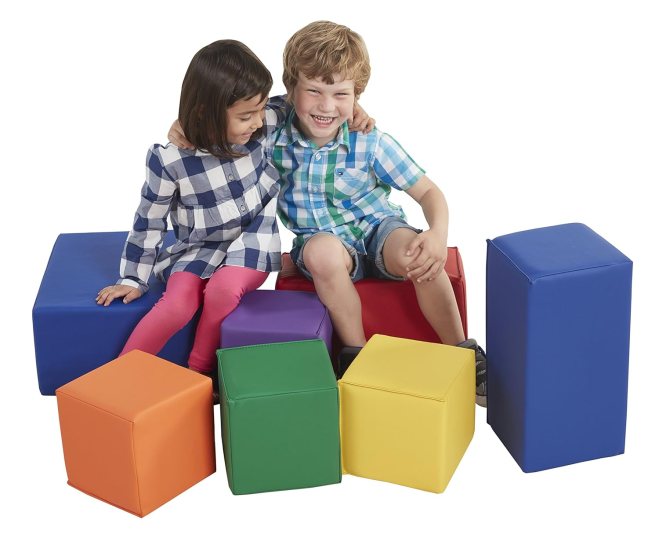
We currently own one set of these foam building blocks. These are great for baby play, as older babies are able to stack the blocks into towers (that aren’t too heavy when they inevitably fall onto another baby), and younger babies are able to crawl onto these and sometimes pull themselves into a sitting or standing position using the blocks.
The exact ramp and stair set that we currently use isn’t available, but this set is very similar and would be a great addition to a set of soft climbing equipment. Our ramp and stair set is much more popular than the building blocks, as babies immediately see the stairs as a crawling or walking challenge. Our ramp has often turned into the setting of various science experiments with babies rolling balls and wheeled vehicles down its smooth surface.
Based on the description, this set also has a bottom strip that allows you to connect the stairs to the ramp. Our set does not have that option, and we have always used them as two pieces (though often positioned them like in the above picture).
These can also be wiped clean.
Conversation Starters
Start conversations as babies play with this tool by asking questions like:
What can you build with the blocks?
Can you walk up the steps?
How far can you throw the block?
Can you stand on top of the ramp?
How fast can you make a tower?
Stretch Vocabulary
When talking with little ones, use big words and small words. The more new words a child hears, the larger their vocabulary will be when they start to learn to read.
Consider using some of the following vocabulary words when using this activity: