While a Stuffed Animal Sleepover is certainly not a unique program idea–a quick Google or Pinterest search will quickly bring up ten or more articles featuring libraries who have run this type of event–it is still one of my favorites. In addition to being downright adorable, it helps young kids practice parting with precious items for a brief amount of time–an important skill.
Last week, we had 17 stuffed friends spend the evening at the library.
Drop Off Storytime
I structure my Stuffed Animal Sleepover with a drop off program and then an all day next day pickup. This evening program means less attendance than we would receive during the day, but it also means providing a program for our working parents.
Our program was designed for ages 2-6 and followed a standard storytime format, with the idea that each child’s stuffed animal acted as their “baby”–meaning the attending children bounced their stuffed animal and helped them participate in the rhymes and songs. The full storytime PowerPoint is available below:
We had some library owned stuffed animals on hand for any drop-in attendees who did not bring their own stuffed animal but wanted to participate.
Before starting the storytime, as families came in, they worked on information sheets for each stuffed animal. These sheets helped us give each stuffed animal the best experience and eased the fears of some of our younger attendees.
We ended our stortime by singing Twinkle Twinkle Little Star with Raffi and putting our stuffed animals to sleep underneath our parachute. We had a few kids who were hesitant to part with their stuffed friends, but they did eventually.
Stuffed Animal Sleepover Photo Time
After the storytime is over, the real fun begins. I had two hours to take as many pictures as possible, design souvenir albums, and assemble the albums. Even with plenty of help, it was a whirlwind few hours!
I had a few planned photos, and everything else was just what worked best at the time. I knew I definitely wanted photos of:
Stuffed Animal Dinner Party
Stuffed Animal Glow Party
Youth Dept. Treehouse
Book Sorter
Some of my favorite photos are below:
After taking pictures, I inserted the pictures into our souvenir photo albums, printed them, and had teen volunteers help stuff the albums so they were ready for pickup the next day. A sample album is featured below (with one of our sample photos featured throughout):
All of our stuffed friends were picked up the next day, with lots of adventures to share with their owners.
I love hosting popular character parties, and in January 2019 I was able to celebrate one of my favorite characters of all time–Winnie the Pooh.
I planned to begin the program by reading a Winnie the Pooh book, but as I looked through the titles we owned, none were really great for a read aloud for preschoolers. After bouncing like Tiggers and talking about Winnie the Pooh, I sent attendees to complete activities.
We regrouped about 20 minutes into the program to play Winnie the Pooh BINGO.
Activity stations included:
Craft: Pooh and Friends Headbands
Game: Pin the Tail on Eeyore
Scavenger Hunt: Count the Bees
Obstacle Course: Catch the Heffalump
Winnie the Pooh BINGO
About 20 minutes into the program, we all played Winnie the Pooh BINGO. We play a few rounds until everyone wins.
Since most of our audience was younger (ages 2-4), these boards only require four in a row to earn a BINGO. BINGO boards can be downloaded here with slips here.
BINGO winners received a Winnie the Pooh Activity book, downloadable here. These were printed on 8.5″ x 11″ paper to create a foldable booklet.
Honey Pot Bags
At many of my party programs, kids create or earn a variety of small trinkets. I learned early on that this turns into parents having a variety of items to carry around and kids leaving items they made all over the place (possibly resulting in tears or arguments later). To help with this, I provide a bag for each child.
These bags, while adorable, were way too much work to make. The dripping honey was cut by hand out of yellow cardstock, and the letters were printed on yellow vinyl by our Cricut. The other side of the bag included a white label with space for kids (or parents) to write their name.
Winnie the Pooh & Friends Headbands
Kids could make a headband to wear based on their preferred character–Pooh, Piglet, or Tigger. Attendees practiced scissor skills and built finger muscles cutting out ears, and parents and teen volunteers assisted with stapling headbands together.
Pin the Tail on Eeyore
Just like it sounds–kids played Pin the Tail on Eeyore. Eeyore and tails were printed on our library banner printer by our marketing department. After winning, they received a Winnie the Pooh sticker (bought off Amazon).
Count the Bees Scavenger Hunt
Thirty-two bumblebees were hidden around our meeting rooms. Kids went on a hunt to find as many bees as they could. If they counted a number 25 or higher, they received a Pooh bookmark.
Participants could complete an age-appropriate “Catch the Heffalump” obstacle course. Kids crossed Pooh Stick’s bridge, crawled into Rabbit’s House (tunnel), dug through Eeyore’s Gloomy Place to find his tail, bounced with Tigger, and completed exercises with Pooh.
Winnie the Pooh Books & Materials
As always at programs, I included a variety of appropriate library materials. Kids and parents sat and Pooh books. During the event (except during BINGO), the Many Adventures of Winnie the Pooh played on the large screen. Many families took Pooh materials home.
Kids have always been afforded coloring sheets, and then adults realized that “hey this is really relaxing” and the adult coloring book craze began…but somehow teens were, for the most part, left out in the coloring cold. When I inherited my teen department it actually came with a a few coloring books for use in house, but they were not really utilized by our teens.
Our current selection of coloring books in the Teen Room
I could tell there was a want, as many times the books would be looked at, but I think they were tired of the books we had and wanted things that were less intricate to color in. So came my quest for some new fun coloring books!
I started trolling Amazon looking for simple pictures, pop culture references, and random odd things. (This can sometimes be harder than it sounds as when the pictures get simplified they can begin to look very juvenile.) However, once you fall down the rabbit hole you can find an amazing plethora of coloring books such as:
Every other week I do wind up going through the coloring books looking for any inappropriate additions to the books, or as I call “my sweep for Ds and Fs”. Any swear words, social media handles, or genitalia drawn in gets pulled from the books. I also will pull any overly scribbled on pages because when there is a lot of scibblage no one will continue to color on that page. I don’t pull all additions from the book though and sometimes you wind up with some greatness.
Occasionally, I will also have a large coloring sheet printed out and I will tape it to a coffee table that I have in the teen room for some “allowed vandalism”. It stays on the table until it is either colored in, has lost the battle to swear words, penises, and “follow me @s”, or my favorite death, having every square inch covered in Old Town Road lyrics and a rainbow of a million “YEETS”. (Does that make it Yeeted to death? Yoted?)
And sometimes you wind up with some gorgeous, collaborative art.
Every month I host a passive activity in the teen room. Sometimes they are repeat styles of something like Coloring, Book-in-a-Bottle or Book Emoji Storylines where the shredded or emoji explained book will change, but the concept stays the same: identify the title. But in October, something magical happens at the Westerville Public Library…the whole building turns into a school for witches and wizards of all ages and we showcase the magic of the library during the Wizards & Wands Festival.
2018 was the first installment of this festival and the outpouring from the community was enormous! This year with one magical festival under our belt the Wizards & Wands Festival has grown even larger and features all kinds of fun activities around the building leading up to the night of festivities. One of those activities is my October Teen Passive: Concentrate on Charms.
All across the largest wall of my Teen Room are different wand movements for spells from the Harry Potter Universe, each one labeled with it’s name for identification purposes, as we can’t all be Hermione and recognize each swish and flick or the different spells/charms.(Thank you Potterhead superfans and Wizards Unite! game for the wand movements) Anyone wishing to participate can snag an answer sheet from the Teen Desk and wander through the stacks to the bright green wall in the hopes of finding the correct spells and drawing out the wand movements necessary to successfully cast it.
Searching the wall for the correct spells can take a bit of time as I only ask for 9 spells to be identified and there are 30 gracing the wall.
Each person can participate once per day and when their answers are returned to the Teen Desk they are awarded one prize ticket that can be turned in for a raffle style drawing during the Wizards & Wands event. While most of my passive activities are limited to teens only, the W&W Themed passive for October is open to all ages. The Wizards & Wands event will be this Friday (October 25, 2019 5-9pm), but Concentrate on Charms will remain up through the end of the month.
This passive activity has already had over 250 answer sheets returned to the Teen Desk and there are still 8 more days to play (2 more days if you are collecting those prize tickets!)
A few times a year, I offer a Make & Take Crafternoon program for our patrons. While this is designed for ages 6+ (some crafts with small pieces are included), this is a family event with a variety of crafting opportunities. This is also a great chance for us to clean out old supplies that have been sitting in our cabients.
While this isn’t my best attended event, it is simpler than most, involving a few stations and teen volunteer help.
At this month’s crafternoon, my activities included:
Button Makers (2.25″ and 1″)
3Doodlers
Perler Beads
Random Craft Corner
Visitors could move between any of the stations as they liked over the 1 hour and 15 minute program. Anything they made they got to keep.
Make & Take Buttons
While our button makers are normally quite popular, they didn’t receive much use during this program. One teen volunteer managed both our 1″ and 2.25″ button makers, both from American Button Machines.
These machines have definitely been worth their relatively high cost. We use the machines as a creation station in programs, and we use the buttons we make as incentives to stop by the library during the summer, prizes for passive activities, and giveaways at large events.
I have a ton of templates with cute button images as well as blank templates that allow kids to design their own buttons. I also put out magazines for kids to find their own images in, but these have not been very popular at my last few programs.
3Doodlers
Our 3Doodlers didn’t get too much use at this event. Typically, they are the star of the show. These amazing pens print a warm plastic that can be molded into any shape before it hardens. While it isn’t recommended you draw on your skin, the pen tip and plastic are never hot enough to burn you. They are great for practicing dexterity and patience for elementary school students, and older kids can make some pretty amazing creations.
Perler Beads
Perler Beads were the most popular activity this week! I was surprised to see the interest, but almost every attendee made at least one Perler Bead creation, with many being quite elaborate, and some involving over 200 beads!
We had an adult volunteer manage the iron. Attendees were welcome to copy templates out of beadcraft books, off of internet images, or to make whatever they could imagine.
Random Make & Take Craft Corner
I always like putting out random craft supplies, as this gives kids the freedom to make anything they would like. While the 3Doodlers and button makers often attract attention, many kids will gravitate towards the hodgepodge of materials to make something simple (like a bracelet) or something more elaborate, like a sock puppet with two heads. We recently had a large donation of empty Pringles cans, and those were the star of the random craft materials this time.
Make & Take Crafternoon is a fun program for me–it is simple to put together with what we have on hand, promotes family engagement, and helps clear out our craft closet. A win all around!
There is nothing quite like the Pokemon fandom. Pokemon love spans all ages–from preschoolers to grown-ups. There is a huge Pokemon following at my library, and this year’s Pokemon Party was no exception, with 150 folks coming together to celebrate.
My unregistered fandom programs over the summer typically include three core elements: group trivia, group BINGO, and a variety of crafts and games that folks can participate in at anytime. The annual Pokemon Party involves a few additional items, including raffle/door prizes as well as a ton of snacks. I normally avoid food in programs, but at each Pokemon event, I have groups of kids who bring binders of trading cards and sit with other kids for the entire two hours. The snacks are meant for them but are available for everyone.
Trivia and BINGO are optional for whoever wants to participate. Trivia is difficult intentionally, with prizes for the Pokemon trivia experts. Everyone who participates gets a sticker, but our top three trivia masters get to pick from some nicer themed prizes (in order from highest to lowest score).
The program outline and all trivia questions are in the below powerpoint. Download here.
BINGO is for everyone. We continue to play until everyone has gotten a BINGO. For many of our youngest players, this is their first ever BINGO game! When someone gets a BINGO, they bring their board to the front of the room and get to reach into a mystery bag filled with tiny Pokemon figurines. One prize-winning BINGO per person.
I got my BINGO boards free from The Eco Friendly Family, and using the extra boards provided, created enough boards to have 50 players at once.
3Doodlers & Button Makers
I use our library tech whenever possible, especially at fandom party programs. The 3Doodler pens made an appearance, with outlines of various Pokemon to trace (Pikachu was the favorite).
Our 2.25″ button maker was also available, with a teen volunteer helping kids make as many buttons as they would like.
Pokeball Ping Pong Balls
This is my third Pokemon event, and I am always on the hunt for new crafts. One of this year’s addition was ping pong balls with sharpies and pictures of Pokeballs. Kids could color their own Pokeballs, with clear rules that they couldn’t throw their new pokeballs during the program.
Trainer Toolbelts
Another new craft for this year was trainer toolbelts. I gave kids black strips of 12″x18″ paper, string to tie to the ends, and various cardstock pokeball designs they could color and cut out. “Pokeballs” could be taped or glued onto “pokebelts” and worn around the waist.
Guess the Pokemon
Guess the Pokemon is an annual favorite game. This year, I used 20 new Pokemon silhouettes. Kids had to identify the Pokemon’s name, check their answers, and pick up a small prize.
Pin the Tail on Pikachu
Exactly what it sounds like. Kids pinned the tail on Pikachu. This was also a return game from past events.
Catch the Pokemon
I wrapped pop cans in Pokemon character faces and colors. Kids threw a stuffed pokeball at the cans in an effort to “catch” the Pokemon by knocking the cans down.
Pokemon Scavenger Hunt
Each year, to advertise my Pokemon Party, I put a Pokemon scavenger hunt around the youth department, adapted from the one created by the Ontarian Librarian. This is always a huge hit, with a few hundred kids completing the scavenger hunt.
After receiving a grant for some technology items two years ago, I’ve been running registered, monthly technology programs for upper elementary school kids (roughly ages 8-12).
These were great programs, except for a few recurring issues:
Each program focuses on one topic or device, and I have a limited number of devices, so a limited number of kids could attend (max. of 20, sometimes as few as 10).
This means that these programs had to be registered. Registration often filled up within 30 minutes of it opening (two weeks before the program date), even when I was offering 2-4 sessions in a month.
Each program, I have a new set of kids with different abilities. Some have coding skills well beyond my own; others have never heard the word “coding” before walking through the door. This made it hard to plan anything too advanced.
While programs were designed for ages 8-12, I often have parents sign up their 5-7-year-olds for my programs. While I am glad they are excited about tech, it makes it even more difficult to teach basic coding to a group of kids with mixed abilities when a few of them can’t even read yet.
This summer, I decided to try something different. Instead of offering weekly registered tech programming, I offered a monthly tech fair. I put out as much technology as could fit in our space and work with the number of tablets we own. I wasn’t sure what to expect with attendance or participation, but overall the programs were a success.
Find more examples of Innovation Academy programs in these posts:
During each month’s tech fair, I strategically planned out how the room was laid out to accommodate the most technology. Almost all of the technology we own was used at some point during the summer–it was a great bonus to see everything out of the cabinets and being used by the public.
Tech I used at least once over the three programs included:
Each technology item was at a different station with a loosely structured activity. As the sessions went on, I realized that structured activities really weren’t necessary. Kids explored the technology in deeper and more creative ways when they had the time to do that on their own without having to focus on specific steps in a task.
Family Engagement
An unexpected outcome of this program was the multi-generational experiences and learning that took place. During my monthly registered tech programs, sibling partners often worked together, but, with rare exceptions, adults stayed outside of the room.
Since the tech fair wasn’t structured in the same way, adults were welcomed into the tech space. Little siblings came too. Third graders showed grandparents how to build a video game with Bloxels. Parents explained to kids how Ozobots use sensors to read color patterns that tell them to complete certain actions. Five-year-olds who didn’t yet have the skills to use the Blocky app with Dash helped create an obstacle course, and an older sibling explained to them how their code worked.
Families walked out of the program with some hands on time with new technology after thinking creatively about ways to take a simple challenge or activity to a new level.
Tech fairs are simpler for me to plan than monthly programs. I am essentially pulling from our supply of tech, charging and pairing everything, and leaving the rest up to our patrons. Registration and age requirements are no longer issues. However, the simplicity in program planning is not why I want to repeat this series–the learning that came from family engagement made this series something to remember.
This coming weekend Cartoon Network is showing every single Steven Universe episode ever, all leading up to the premiere of the new Steven Universe musical on Monday…so this feels like a great time to talk about my Steven Universe Color Party program!
Steven Universe and the Crystal Gems (Pearl, Amethyst and Garnet).(Cartoon Network)
If you are unfamiliar with the TV show Steven Universe let me try and catch you up to speed, even though I will not be able to do the show justice at all. Let me start by saying that it is the most LGBQT+ cartoon you will ever watch, it is political, diverse, and even though the entire premise revolves around alien gem lifeforms with special fighting powers it is completely relatable.
The first season features a goofy kid named Steven and weird alien adventures that he goes on with his female warrior guardians, the Crystal Gems. Steven is learning to master his alien gem powers as he is half human and half gem. His lovable human dad is a bit of an oaf and the other unique and diverse characters in Beach City are all given decently explored back stories which we learn throughout the seasons.
Then season two drops and you get more back story on the Gems and you begin to think wow there is more to this show than just a fun alien saving rainbow world….then seasons three through five having you question how you were lulled into thinking this was anything but an epicly awesome, equality driven ode to love, diversity, rainbows, and truth.
Steven Universe shows human nature better than any TV show I have ever seen. It may be geared for kids, tweens, and teens, but it does not shy away from big issues or dumb down it’s content. It walks the line of having pop culture appeal and being topically relevant to society which is why I think so many of my kids gravitate towards it. And is why this summer we needed to have a fun, light hearted party to celebrate the alien space gem warriors.
I planned stations and activities based upon the Crystal Gems’s strengths where each attendee got to go through different “training” with each Gem and of course it had to be very colorful.
Pearl
Pearl is the mom figure of the group. She is always looking out for Steven’s best interest and trying to guide him through life. While she is a stickler for rules, Pearl understands that Steven learns in his own way and helps teach him skills he needs as a Crystal Gem, like bubbling.
(Cartoon Network)
For Pearl’s station we worked on our bubbling skills. I added various food coloring colors to bubble mix and had teens blow bubbles using the colored mixture at white paper. You can also place bubble mix in cups and use a straw to blow bubbles in the cup until the mixture overflows for more intense bubble shadows.
Garnet is actully a gem fusion. She is the combination of Ruby and Sapphire. So for her station teens got to play with my giant spin art machine* and fuse colors together.
Amethyst
Amethyst is a bit of a rebel in the group. She is the gem that pushes boundaries and speaks her mind bluntly. Amethyst also has a fun kid like streak to her perosnality. Since everything is very straight forward, upfront and fun with Amethyst we needed an activity that fit that criteria.
So instead of Steven Tag we played Rainbow Tag!
Rainbow tag is exactly like regular tag only all players are running around with handfuls of color run or Holi Festival powder*. The regular rules of the game still apply, but with a twist. One person is it and will chase other players in a designated area trying to tag someone, if they succeed the tagged individual becomes the next person that is it and the cycle continues. The twist is that instead of tagging someone by tapping them with a hand, Rainbow Tag lets you tag someone by throwing your handful of color powder at another player. The game ends when you run out of powders or out of energy to run around, whichever comes first.
Peridot & Lapis Lazuli
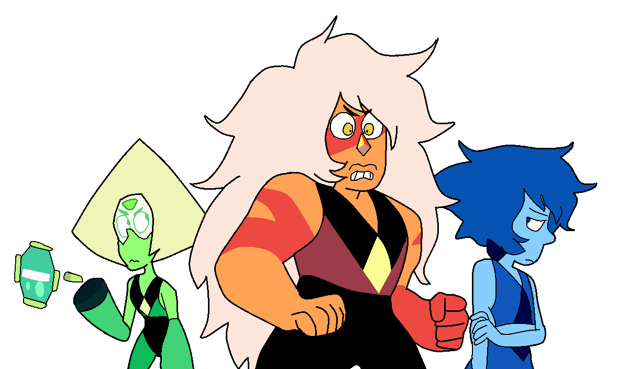
Peridot and Lapis Lazuli are newer members of the Crystal Gems. (Another member of the squad that could have been included in this activity is Jasper, but I had to cut her out of this area as my printer decided it was no longer going to print properly and was unable to have her repped during the program.) Peridot was a mathematical Home World Gem that was converted to the ideas of the Crystal Gems and began to fight to save humanity. Lapis Lazuli is a water based Gem that had been fractured during the first Gem War and was bubbled for safety reasons until freed by Steven. (The militant, Jasper was also a Home World Gem and had a longer redemption arc before joining the Crystal Gems.
Lapis Jasper Peridot sketch By Peri.png
This final station was all about accuracy, power, and water, which could only mean…..water balloons! Teens got to aim and throw water balloons filled with colored water at targets to improve their Crystal Gem fighting skills.
All in all we had an awesome time and there was a lot of very heated discussions about Crystal Gems and their character flaws while having fun with art!
*Giant spin art machine and DIY color run powder directions will be featured in next week’s blog post
Mother Bruce is one of my favorite book characters. If you haven’t read, or, even better, listened to, the book Mother Bruce by Ryan T. Higgins, track down a copy now. It is a funny read, perfect for preschool through first or second grade. The audiobook, read by Roberston Dean, is a particular favorite of mine with excellent pacing, great sound effects, and an original musical score that brings the grumpy old bear to life.
I was determined to celebrate one of my favorite storytime characters at the library. We had a great Saturday morning with a family storytime and a visit from Bruce himself!
After storytime, folks were welcome to participate in a variety of themed activities. These included:
Mother Bruce Ears & Gosling Craft
Visitors cut out bear ears and attached them to brown headbands. Optionally, they could also cut out yellow goslings to tape to a string hanging off the back of their headband (so your goslings would follow you everywhere, just like Bruce’s). Download here.
Goin’ On a Bear Hunt Obstacle Course
No preschool program is complete without some physical fun. Little ones explored our Goin’ On a Bear Hunt obstacle course. They completed some of the activities we did as a group during storytime including climbing a mountain, crossing a river, walking through a wheat field, and going into a cave to find our bear puppet.
Find the Goslings Scavenger Hunt
Ten goslings were hidden around our meeting room, and little ones had to find them all! When they found all ten geese, they got to pick a Mother Bruce bookmark. Download the scavenger hunt sheet here.
Download geese to hide around your room or library here.
Gosling Match
I love to give little ones an opportunity to play in water. Just like a fair game, little ones could pick up rubber “goslings” and try to find two with matching colored bottoms.
This didn’t work quite as planned, as my ducks shifted and didn’t want to stay bottoms down in the water.
Meet Bruce!
The star of the event–Bruce came to visit! After sufficient warning to prepare little ones for a visit from the big bear, Bruce stopped by for photos and to participate in the crafts and activities. The Costume Specialist store in Columbus, Ohio lets libraries borrow book character costumes for free, and these visits always make an exciting addition to any program.
I am incredibly lucky to have a large base of teen volunteers to help at Westerville Public Library. Part of that is because of school requirements; high schoolers and middle schoolers have community service time as a graduation requirement in Westerville City School District. I also have many teens who are actively seeking scholarships or involved in extracurriculars that require or encourage helping out in the community that they live. All in all I have a little over 350 active teen volunteers every school year. The thing is, all of those teens need to be trained – so, each month, I run Teen Volunteer Training.
On the third Monday of each month, I can be found leading a one hour teen volunteer training session for ages 12-18. During the school year training covers how to help out at library programs and how to shelve materials in designated areas. Teens that attend training can begin selecting desired shifts and putting in some hours at the library for whatever their community service needs they have the very next day. (I really love how streamlined it has become.)
The training session is really simple. We lightly touch on the types of programs that teens can help at (storytimes, parties, special events, etc.) as well as special assignments that can become available throughout the year (making buttons, cutting out crafts, placing stickers, etc.). Because each program and librarian requesting the help is unique and the needs vary we do not spend a lot of time on this subject. However the basics of what is expected for helping at programs is covered, as well as talking about the general personalities; i.e. if you aren’t a fan of little kids….storytimes might not be your best fit. The WPL website also provides a link to a Google doc I maintain listing descriptions of more specific tasks that volunteers would be doing at each event.
The majority of the hour is focused on shelving training. Teens are able to help return materials in 3 locations: J Fiction, Teen Fiction, and DVDs. Spine labels and call numbers are explained, examples of different stickers that may be seen on books are shown, and then we get into the nitty gritty of the ABCs.
Like most fictions sections, our books are organized alphabetically by the author’s last name, then first name, then within that specific area the title of the book and/or series. I annoy my kids with several slides showing exactly what I mean by “author’s with the same last name” and that no matter how awesome you are about know series order they still go alphabetically. And then I up the ante and make them move and do things.
I start out getting groans and mumbles because I
have us all sing the ABCs together and will stop or slow down if I don’t get
participation from attendees.
When teens show up at the beginning of the training I have the attendance sheet for sign-in* and everyone receives a beautiful paper with their last and first name on it. This paper comes into play after our lovely a capella, because it is actually their spine label featuring their very own call number. Each teenager is now a book and collectively they need to alphabetize themselves as if they are being placed on a shelf.
Then comes the next physical movement and moment where teens will have to intereact with each other. Basket sorting! When setting up for the program I pull 10 items from each designated shelving area mix them up so they are out of alphabetical order and place each grouping in a basket for the trainees to sort and alphabetize while working together. Each team of teens will wind up sorting each basket of materials so that they can work with the items in a controlled environment. I, of course, throw some curve balls in the mix to make sure they all understand the order of author’s last name > author’s first name > title alphabetical system that we use and can correct any missteps along the way.
Then we get to do the super happy fun times tour
and visit the areas where they get to shelve items! Starting in the Teen Dept.
I show volunteers where to collect items needing to be shelved, where they get
placed, and how to move book ends around. Most of the shelving in this area has
bookends that are connected to the stacks and I teach them how to not only move
the brackets back and forth along the track, but how to get them back in when
they come out. Everyone get to “break a shelf” and practice moving
the brackets and replacing them back properly.
DVD land is next with the same start as Teen,
showing where to collect materials they get to re-shelve as service. Bonus time
though because I sneak in one more round of alphabetizing training and have
everyone select a DVD to shelve, let them loose in the stacks, and follow
behind checking their placement to ensure we have it down. While they are
winding through the stacks with DVDs in hand I remind them that shelving is not
a race and that accuracy is key and what we are really looking for. If they
need to sing the ABCs to themselves or take a minute to make sure it is being
placed right, then do so. An item not in the correct location is as good as
lost until it someone finds it.
After DVDs have been explored the last stop on
the tour is the Youth Dept. We learn where materials to be shelved are located
and have a look at the unique layout of the stacks in the area and I explain
how to shift shelves. Because of our checkout rate and pages staying on top of
things, very rarely do our volunteers need to know how to shift materials,
however I’d rather have them armed with that knowledge than stumble across over
packed shelves later.
At the end of the tour, we go over how to sign up for shifts using our system (which will be explained in a post on another day). And I implore them to please ask any questions and to make sure that they have things spelled correctly on the attendance sheet before I let them escape to the outside world armed with new knowledge, a pocket-sized handout on shelving basics, and my business card.
*Note: I try to keep registered programming to a minimum, however Teen Volunteer Training is one of those I do ask for sign-up. It helps me more easily check for applications and have the spine labels printed beforehand, as well as foreshadows IRL to the teens that they will need to sign up for things…like shifts. Teen Volunteer Training is also the one registered program that is the exception to the rule that only registered individuals can attend. I keep blank spine label forms in case I have kiddos wandering in to go through training so that they can be books too and we talk about responsibilities and signing up for things at the end of the training.