My coworker, Sarah Simpson, and I have the pleasure of presenting to our colleagues at the 2019 Ohio Library Council Convention and Expo today about our passion and programs for babies in the session Baby Time Boredom. Hopefully some of you reading this post had a chance to see our presentation (and learn some fantastic babywearing dance moves).
Check out these posts for some more information about some of the programs and activities we mentioned in our Baby Time Boredom presentation:
Baby Storytime Outlines (These are both from before our most recent program tweaks, so they may look a little different than what was discussed in the presentation.)
After each of my baby storytimes, I include a Discovery Time free-play session that encourages parents to talk to one another and to interact with their children. I include a variety of fine motor, gross motor, and sensory activities that appeal to 0-2-year-olds.
In most of my baby play posts, I talk about items that are easy and relatively cheap to replicate, often with items found around the house or at Dollar Tree. I love using play items like cereal boxes and straws and taped toys because they provide parents with ideas that they can easily recreate on their own and remind everyone that baby toys don’t have to be super expensive.
However, if a library has the budget, it can also be nice to provide some of those more expensive play items. For more affluent parents, you are providing them an opportunity to test out some baby items before making the decision to purchase something. For those families with less funds, you are giving their little ones an opportunity to interact with a type of toy they may not be able to experience at home.
Play mats and soft climbing and building blocks are perfect examples of more pricey baby play equipment that may not be ideal for many homes. In addition to being expensive, these take up a lot of room (storage is a definite consideration for a library as well).
Due to the size of these items, babies interact with these tools differently than they do with many of the make-at-home play ideas. Those make-at-home activities almost always focus on fine-motor skills and sensory exploration; play mats and equipment help develop large gross motor skills, for crawlers, wobblers, and walkers.
Recommended Play Mats to Purchase
Play mats and equipment are not cheap–a good collection could cost your library $200+. However, for our library, these items have become a staple in all of our baby storytimes. The mats and climbing cubes are used 2-4 times a week, with at least 10-15 babies interacting with the equipment per storytime play session. Since purchasing our set late last year, these tools have been used in at least 100 programs, including weekly storytimes, preschool and school-age programs (as parts of obstacle courses), and special baby and toddler programming.
My coworker found these fantastic folding gym mats at IKEA. They fold up to a reasonable size (18″ W x 31″ L x 5″ D), allowing us to stack them on top of each other in our storytime cupboards. We wipe them clean each week.
BestMassage Gymnastics Mat Gym Mat Tumbling Mat 4 Pannel Foldding Gymnastic Tumbling Mat – $78.99 http://amzn.com/B00IESHCN8
If you aren’t near an IKEA or are looking for something a little bigger, these mats may work for you. Keep in mind that they are larger (they fold to 24″ W x 48″ L x 8″ D), and they cost twice as much per mat as the IKEA mats.
They are thicker mats, providing more support on hard floors. They will cover a larger area. They can also be wiped clean.
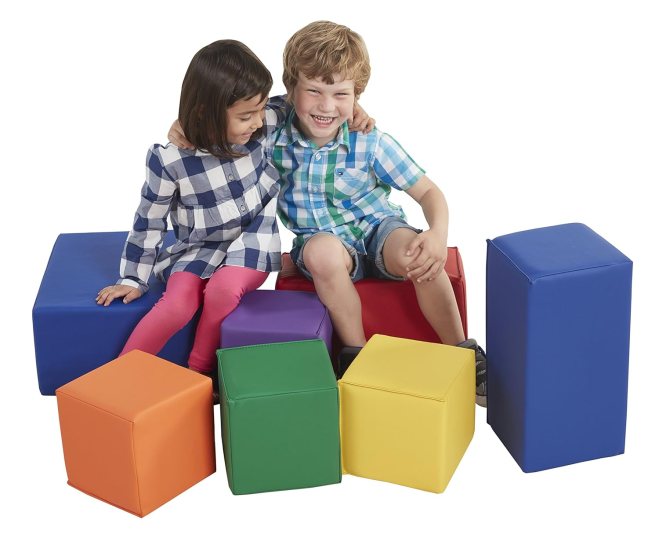
We currently own one set of these foam building blocks. These are great for baby play, as older babies are able to stack the blocks into towers (that aren’t too heavy when they inevitably fall onto another baby), and younger babies are able to crawl onto these and sometimes pull themselves into a sitting or standing position using the blocks.
The exact ramp and stair set that we currently use isn’t available, but this set is very similar and would be a great addition to a set of soft climbing equipment. Our ramp and stair set is much more popular than the building blocks, as babies immediately see the stairs as a crawling or walking challenge. Our ramp has often turned into the setting of various science experiments with babies rolling balls and wheeled vehicles down its smooth surface.
Based on the description, this set also has a bottom strip that allows you to connect the stairs to the ramp. Our set does not have that option, and we have always used them as two pieces (though often positioned them like in the above picture).
These can also be wiped clean.
Conversation Starters
Start conversations as babies play with this tool by asking questions like:
What can you build with the blocks?
Can you walk up the steps?
How far can you throw the block?
Can you stand on top of the ramp?
How fast can you make a tower?
Stretch Vocabulary
When talking with little ones, use big words and small words. The more new words a child hears, the larger their vocabulary will be when they start to learn to read.
Consider using some of the following vocabulary words when using this activity:
After each of my baby storytimes, I include a Discovery Time free-play session that encourages parents to talk to one another and to interact with their children. I include a variety of fine motor, gross motor, and sensory activities that appeal to 0-2-year-olds.
Babies love a challenge. Making their regular favorite items just the smallest amount harder to access can be just enough to serve as an interesting distraction and build strong finger muscles needed for writing when they are older.
Taped toys are a very simple (and very cheap) project that just requires a little time ahead of a storytime to prepare. Use masking tape to tape baby-safe toys or household items to a hard surface. Favorite toys, instruments used in storytime, or bright, colorful items help make this a more appealing activity.
How to Make Taped Toys
Materials: hard surface (preferably not going to peel when tape is pulled off), masking tape, baby-safe toys or household objects
Steps:
Tape toys to hard surface. Use one long strip of tape per toy (more if working with older kids).
Cost: $0-5
Masking Tape
Hard Surface (Cardboard, Tri-Fold Board, Magnet Board, etc.)
Time to Make: 10 minutes
Pro-Tip: While cardboard is normally much easier to access, our department magnet/dry erase board, that we use for outreach, doesn’t show the damage of having masking tape peeled off repeatedly.
Conversation Starters
Start conversations as babies play with this tool by asking questions like:
What toys do you see?
What color is that toy?
How can you get the toy off the board?
What does the tape feel like?
Does the toy make a sound?
What does the toy fee like?
Stretch Vocabulary
When talking with little ones, use big words and small words. The more new words a child hears, the larger their vocabulary will be when they start to learn to read.
Consider using some of the following vocabulary words when using this activity:
After each of my baby storytimes, I include a Discovery Time free-play session that encourages parents to talk to one another and to interact with their children. I include a variety of fine motor, gross motor, and sensory activities that appeal to 0-2-year-olds.
Babies are naturally curious about the world around them. Pipe cleaners are a fascinating tool that has an interesting texture and can be bent into a variety of shapes. The holes in a standard kitchen colander are large enough for a pipe cleaner to be woven through with nimble finger muscles.
These colander sculptures very quickly turn into awesome pipe cleaner colander hats. The littlest babies enjoy putting the plain colander on their (and their adult’s) head; the older ones like making all kinds of fascinating creations by weaving the pipe cleaners into the tiny holes.
How to Make Pipe Cleaner Colander Hats
Materials: colanders, pipe cleaners
Steps:
Make one sample.
Put out collection of pipe cleaners and colanders.
Cost: $10+ (cost depends on audience size)
Colanders (Dollar Tree)
Pipe Cleaners (packs at Dollar Tree or Walmart)
Time to Make: < 5 minutes
Pro-Tip: I typically make a sample of this particular activity to help parents understand the goal, especially is this is one of a collection of activities. Otherwise I end up with a lot of confused faces (and colander hats–there are always colander hats).
Conversation Starters
Start conversations as babies play with this tool by asking questions like:
What do the pipe cleaners feel like?
What direction are you pulling that pipe cleaner?
What color should we add next?
What did you make? Is that a hat? A porcupine?
Can you find a purple pipe cleaner?
Can you twist two pipe cleaners together?
Can you make the pipe cleaner into a happy face?
Stretch Vocabulary
When talking with little ones, use big words and small words. The more new words a child hears, the larger their vocabulary will be when they start to learn to read.
Consider using some of the following vocabulary words when using this activity:
After each of my baby storytimes, I include a Discovery Time free-play session that encourages parents to talk to one another and to interact with their children. I include a variety of fine motor, gross motor, and sensory activities that appeal to 0-2-year-olds.
Texture tiles have been a big hit at my storytimes (though not quite as successful as my coworker’s liquid sensory tiles–more on those in another few weeks). Various textured items are hot glued, zip tied, or otherwise secured to foam puzzle tiles.
I put these out in a big stack, and the kids decide whether they want to interact with individual tiles or if they want to connect different tiles together.
Textures can include:
Sandpaper
Cardboard
Bubble Wrap
Felt
Foam
Carpet Square
Craft Sticks
Thin Wood
Pom Poms
Googly Eyes
Fur
Memory Foam
Pipe Cleaners
Rocks/Moss
I found circular, pre-made thin “stepping stones” at Michaels a few years ago. The rocks seem to be permanently fixed to the thin sheet, as I’ve never had one break off. I can’t find a similar item online at the moment–if you know of something like this, please share in the comments below.
How to Make Texture Tiles
Materials: 12″ x 12″ foam puzzle tiles, various sensory surfaces (I used what was on hand), hot glue
Steps:
Decide how many tiles you are going to make.
Cut textures to smaller than the size of the tiles (about 10″ x 10″)
Hot glue to attach textures to tiles (or use other adhesives as necessary).
After glue has dried, thoroughly test all surfaces to make sure items are stuck to the tiles.
Pro-Tip: Make sure to check these tiles after each use, especially if you plan to attach smaller items (pom poms, googly eyes, rocks, etc.). After many weeks of using these, I have a fairly good idea which tiles will need reinforced.
Conversation Starters
Start conversations as babies play with this tool by asking questions like:
How does that surface feel?
Which texture do you like best—the bumpy one or the squishy one?
Can you hop on the soft part?
Can you walk very slowly?
What happens when you step on that surface?
What color is that texture?
Stretch Vocabulary
When talking with little ones, use big words and small words. The more new words a child hears, the larger their vocabulary will be when they start to learn to read.
Consider using some of the following vocabulary words when using this activity:
After each of my baby storytimes, I include a Discovery Time free-play session that encourages parents to talk to one another and to interact with their children. I include a variety of fine motor, gross motor, and sensory activities that appeal to 0-2-year-olds.
I’ve been interested in creating a large pom pom drop for a while, and I finally had the opportunity when a coworker donated over 20 empty Pringles cans to the youth department. Walking babies and toddlers particularly enjoyed grasping the 2″ pom poms and watching them fall through the colorful tubes.
In addition to developing those ever-important fine motor skills, little ones learned about cause and effect as they dropped pom poms through different tubes at different heights.
How to Make a Pom Pom Drop
Materials: hard backing material (we used leftover insulation board from a previous project), empty Pringles cans, construction paper, hot glue, packing tape, sharp kitchen knife, 2″ pom poms
Steps:
Enforce edges of backing material as needed to make sure nothing is sharp or peeling.
Use sharp, large kitchen knife to cut empty Pringles cans to a variety of lengths. At a minimum, the knife works great to cut an inch or so above the metal bottom of the can, removing all of the sharp bits in one cut. (There are tutorials online about using a can opener for this process, but I could never get it to work cleanly without something sharp being left behind.)
Measure your cut can’s length. Cut a piece of construction paper to the same length.
Optional: Laminate the construction paper for extra durability.
Wrap the construction paper around the can and tape it on securely.
Hot glue construction-paper-wrapped cans to the backing materials.
As needed, further secure each can by wrapping packing tape around the front to secure it to the board.
Cost: $20+ (cost depends on backing material and number of pom poms)
Backing Material (use what you have on hand, we used insulation board like this)
Pro-Tip: Ball pit balls also fit through Pringles cans! If you have limited resources, ball pit balls have many uses and are easier to clean than pom poms.
Conversation Starters
Start conversations as babies play with this tool by asking questions like:
Can you drop the pom pom in a tube?
What happens when the pom pom goes into a tube?
What color is the pom pom?
How does the pom pom feel?
What happens if the tube is at an angle?
How many pom poms can you drop through the tubes?
Can you catch a falling pom pom?
Stretch Vocabulary
When talking with little ones, use big words and small words. The more new words a child hears, the larger their vocabulary will be when they start to learn to read.
Consider using some of the following vocabulary words when using this activity:
Mother Bruce is one of my favorite book characters. If you haven’t read, or, even better, listened to, the book Mother Bruce by Ryan T. Higgins, track down a copy now. It is a funny read, perfect for preschool through first or second grade. The audiobook, read by Roberston Dean, is a particular favorite of mine with excellent pacing, great sound effects, and an original musical score that brings the grumpy old bear to life.
I was determined to celebrate one of my favorite storytime characters at the library. We had a great Saturday morning with a family storytime and a visit from Bruce himself!
After storytime, folks were welcome to participate in a variety of themed activities. These included:
Mother Bruce Ears & Gosling Craft
Visitors cut out bear ears and attached them to brown headbands. Optionally, they could also cut out yellow goslings to tape to a string hanging off the back of their headband (so your goslings would follow you everywhere, just like Bruce’s). Download here.
Goin’ On a Bear Hunt Obstacle Course
No preschool program is complete without some physical fun. Little ones explored our Goin’ On a Bear Hunt obstacle course. They completed some of the activities we did as a group during storytime including climbing a mountain, crossing a river, walking through a wheat field, and going into a cave to find our bear puppet.
Find the Goslings Scavenger Hunt
Ten goslings were hidden around our meeting room, and little ones had to find them all! When they found all ten geese, they got to pick a Mother Bruce bookmark. Download the scavenger hunt sheet here.
Download geese to hide around your room or library here.
Gosling Match
I love to give little ones an opportunity to play in water. Just like a fair game, little ones could pick up rubber “goslings” and try to find two with matching colored bottoms.
This didn’t work quite as planned, as my ducks shifted and didn’t want to stay bottoms down in the water.
Meet Bruce!
The star of the event–Bruce came to visit! After sufficient warning to prepare little ones for a visit from the big bear, Bruce stopped by for photos and to participate in the crafts and activities. The Costume Specialist store in Columbus, Ohio lets libraries borrow book character costumes for free, and these visits always make an exciting addition to any program.
After each of my baby storytimes, I include a Discovery Time free-play session that encourages parents to talk to one another and to interact with their children. I include a variety of fine motor, gross motor, and sensory activities that appeal to 0-2-year-olds.
Baby pool play is a staple of my weekly after-storytime play. Baby pools are incredibly versatile, acting as a ball pit, a storage bin for puppets, or a container for some extra messy sensory play.
There is no end to the types of items you can put in a baby pool. My favorites include:
Ball Pit Balls
Pool Noodle Pieces (supervise–watch for chewing)
Easter Grass
Shredded Paper
Unrolled receipt paper
Puppets
Balloons
2″+ Pom Poms
Messy items can be put in a smaller bin that is placed inside the larger baby pool. This helps contain the mess (at least a little). Messy play items can include:
Rice
Sand
Beans
Water
Baby Pool Play Ideas
Materials: hard-plastic baby pool, choice of filling
Steps:
Fill pool with chosen materials
Cost: $10+ (cost depends on audience size and choice of filling)
Pro-Tip: Hard plastic pools are more durable than inflatable pools and are a little harder for babies to flip over, dumping out the contents (sometimes including other babies). However, inflatable pools are easier to store and accomplish the same goal.
Conversation Starters
Start conversations as babies play with this tool by asking questions like:
What does the ball feel like?
How many balls can you pick up at once?
Can you hide your arms under the balls?
How much grass/paper can you pick up?
Can you put the grass on your head?
Can you find a yellow pool noodle?
What color is the pool noodle?
Stretch Vocabulary
When talking with little ones, use big words and small words. The more new words a child hears, the larger their vocabulary will be when they start to learn to read.
Consider using some of the following vocabulary words when using this activity:
These are the songs, rhymes, stories, and activities I used for a 25-minute baby storytime, followed by 20 minutes of free play.
Our baby storytime is for ages 0-24 months, with most children being 12-24 months old. Approximately 85 people attended this storytime, including about 50 babies.
Room Setup: Doors open about 5-8 minutes before storytime. Powerpoint slides are displayed on a smartboard at the front of the room with words to all songs and rhymes. As folks enter, two bubble machines are hard at work in the front of the room while baby songs play from the department iTunes account.
Welcome Song:Wake Up Feet (play from 0:14 to 1:00) Wake up feet, wake up feet Wake up feet and wiggle, wiggle, wiggle Wake up feet, wake up feet Wake and wiggle in the morning. Continue with:Legs, Arms, Hands
Welcome Rhyme:Clap and Sing Hello We clap and sing hello, We clap and sing hello, With all our friends at storytime, We clap and sing hello! Continue with: kick and sing hello, wave and sing hello
Focused Early Literacy Tip: Babies focus on the work spoken immediately after their name. For example, if you say, “Raven, do you want to read a book?”, the child focuses on the word “do.” Instead, try saying “Raven, book. Do you want to read a book?”
Book: Up!: How Families Around the World Carry Their Little Ones by Susan Hughes
Body Rhyme: Everybody Knows Everybody knows that I love your toes! Everybody knows that I love your toes! I love your eyes, Your ears, Your mouth And your nose! But everybody knows that I love your toes!
Movement Rhymes: This portion of my storytime involves 2-3 rhymes that specifically focus on bouncing, swaying, or tilting to the rhythm of the words. I talk about how these types of rhymes help develop phonological awareness.
Zoom, Zoom, Zoom Zoom, zoom, zoom We’re going to the moon. Zoom, zoom, zoom, We’ll get there very soon. In 5, 4, 3, 2, 1… BLAST OFF! (lift)
Tick-Tock Tick-tock, tick-tock, (sway) I’m a little cuckoo clock. Tick-tock, tick-tock, Now it’s almost one o-clock. Cuckoo! (lift)
Humpty Dumpty (sway) Rock and rock and rock on the wall, Rock and rock; I hope we don’t fall.
(sway) Humpty Dumpty say on a wall Humpty Dumpty had a great fall! (tilt backwards)
(bounce fast) All the kings horses and all the kinds men Couldn’t put Humpty together again!
Puppet Time: Retold abbreviated version of book Dear Zoo.
Manipulative Time: Scarves
Manipulative Rhyme: We Shake and Shake We shake and shake and shake and stop. We shake and shake and shake and stop. We shake and shake and shake and shake and shake and shake and shake and shake and shake and shake and STOP! Continue with: Wave, Jump
Manipulative Song: Milkshake Song from Old Town School of Folk Music
Closing Song: Skinnamarink by Sharon Lois and Bram
Discovery Time Activities: Discovery Time is 15-20 minutes of free-play at the end of storytime that encourages parents to have time to talk to one another and for parents to interact with their children. I try to include a variety of fine motor, gross motor, and sensory activities that appeal to my wide age range as well as a mixture of purchased toys and items that parents can remake at home. This week’s activities included:
After each of my baby storytimes, I include a Discovery Time free-play session that encourages parents to talk to one another and to interact with their children. I include a variety of fine motor, gross motor, and sensory activities that appeal to 0-2-year-olds.
Babies LOVE playing in water, and I love to provide opportunities for them to do so! However, it gets cold in Ohio and not every parent is thrilled about their little one potentially getting soaked after storytime.
Water painting creates the best of both worlds: babies get to play with water while staying dry (and practicing fine motor skills).
Each little one gets a hard surface (trays work well), a piece of construction paper, and a paint brush. Adults get a cup filled about one-third with water. Kids can dip the paintbrush in the water and paint squiggles on the paper (or whatever other surface is nearby).
Setting Up Water Painting Play
Materials: hard surface, construction paper, paintbrushes (that are only used for water play–babies will put these in their mouths), reusable cups, bucket for clean water, bucket for dirty water, paper towels
Steps:
Setup station with materials listed above.
Put construction paper on a tray.
Adult fills reusable cup with clean water.
Child “paints” as long as they like.
Cost: < $10
Paintbrushes (Dollar Tree)
Construction Paper Pack
Time to Setup: < 5 minutes
Pro-Tip: The water shows up better on lighter colored construction paper.
Conversation Starters
Start conversations as babies play with this tool by asking questions like:
What does the water feel like?
What can you draw?
What happens to the paper when you put water on it?
Can you draw a circle?
What happens if you use less water?
How does the paper feel before and after you paint with water?
Stretch Vocabulary
When talking with little ones, use big words and small words. The more new words a child hears, the larger their vocabulary will be when they start to learn to read.
Consider using some of the following vocabulary words when using this activity: