Sarah and I were thrilled to present at the latest Public Library Association (PLA) conference (held near our libraries – in Columbus, Ohio!) a few weeks ago. Our presentation, Babytime Boredom: Building Culturally Responsive Programming for Ages 0-3, had nearly 450 (!!) people attend.
Plus, some awesome ALSC Bloggers talked about our presentation:
This presentation really highlighted a lot of the amazing work that Sarah has done at OSU’s Schoenbaum Family Center, with me highlighting ways to apply those concepts in a public library setting.
We wanted to continue to share the content that we created for this presentation – even for folks who couldn’t attend PLA. Find all of those resources below!
I don’t program quite as much as I used to (and particularly not as much as I did during work-from-home pandemic times!). Stepping into management has meant stepping back from day-to-day programming. Most of my programming is filling in when my team are off.
I still enjoy programming, but since presenting programs is now adjacent to my job rather than its primary function, when I do program, I find myself repeating or reimagining programs I’ve done before. One of my favorite programs from both my current and last library has been a Pint-Sized Paint Party.
Pint-Sized Paint Party Logistics
Program Length: 45 minutes – 1 hour
Ages: 6 months – 5 years
Structure: station-based drop-in
5-8 stations spread out in a large programming room
Tarps on the floor under potentially messy areas
Mixture of clean and messy stations, though everything is non-toxic and washable
Prep: Decent amount of pre-program prep but almost all tasks can be done by volunteers (freezing paint cubes, opening paint bottles, stuffing bags, securing tarps to floor)
Pint-Sized Paint Party Stations
Paint-in-a-Bag Activities (Clean)
Participants could choose from a selection of 3 contained paint activities:
Bubble Wrap Pack (5 x 7 clear bubble wrap envelope with cardstock inside)
LOVE Canvas Bag (9 x 12 canvas with the letters LOVE taped in painter’s tape, all in a large freezer gallon-sized ziploc bag) Inspired by Eat Teach Laugh Craft.
Shaker (circular food container with piece of white cardstock and ping-pong ball inside)
Participants brought their selection to staff or teen volunteers who added drips of up to 3 colors of paint before taping the item shut with packing tape.
Families took their creations home with them to dry – though the LOVE canvases most resembled a long-term keepsake.
Ice Cube Painting (Messy)
Kids selected a frozen paint cube to color on cardstock as the paint melted.
I’ve read blog posts about folks successfully doing this with water and food coloring, but I’ve never got this to work well (the water melts, but it remains clear on paper).
Instead, I froze Crayola Washable Paint in ice cube trays with half-popsicle-sticks inside each cube. (And plenty of written and verbal warnings to caregivers that those cubes are all paint.)
The timing can be mildly tricky – the cubes should come out of the ice cube trays within a few minutes of coming out of the freezer. They can sit in a different container until they are used, but if you leave the melting cubes in the ice cube trays, they will start to stick to the tray and collapse.
Of course, you don’t want to take them out of the freezer too early, or they will melt before a kid can use them.
If you take them out too close to painting, they won’t have melted enough and kids will grow frustrated that nothing is happening.
While that sounds complicated – it really isn’t too bad in practice. Kids liked touching and manipulating the paint with their hands, and the frozen-style kept the mess pretty contained.
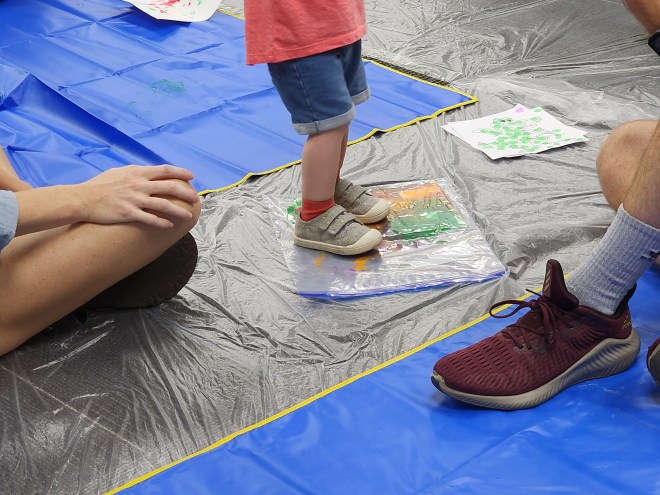
Kids pushed, poked, and explored freezer Ziploc bags with paint inside. They experimented with mixing colors.
Bags were securely taped to a wall or large moveable dry-erase board.
Dot Markers (Clean-ish)
Not quite paint, but close! Kids used dot markers to color pre-printed coloring pages or to make their own creations.
Art Crawl (Messy)
I only ran this station at one library – the station is fun, but the setup takes a lot of time. I used a freestanding baby-gate setup to create an enclosed area layered with tarps on the ground and butcher paper on top. I added piles of paint and various toddler paint toys, and then…I let the babies have fun!
This was supremely messy and required lots of cleaning supplies for caregivers. Not too many caregivers dared to put their babies in the paint pit – but those who did had a blast.
Other Toys
To help keep the youngest ones engaged, I also put out a variety of on-hand brightly colored baby-friendly toys, such as:
Often the best blueprints for programming come from what other awesome library professionals have created. Woodridge Public Library did several months of a Baby Activity Kit program which was absolutely brilliant and something I was eager to build upon and tweak to fit my typical kit structure. Babies are difficult to reach with programming amidst the pandemic and I was looking for a way that I could make a beneficial, early literacy-themed kit for them. This particular kit focused on music and movement with materials to make several instruments included. I rounded it off with activity cards and an instructional packet with book recommendations and further resources included.
Inside the kit were materials to create a:
This program would pair well with any pre-K or school-age reading program in a school or library setting.
jingle bell egg shaker
ribbon whisk
gumball capsule bean shaker
Safety was the top priority, so I included small rolls of washi tape in each kit to secure the egg and gumball capsule so that no choking hazard-sized bits would escape their containers.
Photos of the finished products:
The kit came with several items:
Laminated activity card booklet
Packet including instructions, online resources, and book recommendations
Materials to create each instrument
Scarf – there are several purchasing options on Amazon
Images of the activity cards:
Unfortunately, I didn’t have a fully enrolled program. I thought it would be more popular than it turned out to be with 11 out of 30 spots filled. I was toying with the idea of making this a series, much in the way Woodridge Public Library did, but because of the lack of interset I will not be creating addtional Little Learner kits.
Hopefully, if you try this program, you will have more luck with interest. If you would like PDFs or editable files, please please feel free to reach out to bookcartqueens@gmail.com to request the files.
The concept for this kit was a reimagining of Bluffton Public Library’s program. I absolutely loved their idea and structure, but I made some adjustments to make my program activity-focused. The assembled activities for Reading Buddies were geared towards a broad range of ages (3-11). It was my hope that this kit would entice kids to enroll in our summer reading program and read to their buddy all summer long. To support this aim, I included several pages of reading recommendations for the age ranges 3-5, 6-8, and 9-11 and supplemental information about our summer reading program and events.
This program would pair well with any pre-K or school-age reading program in a school or library setting.
The kit came with several items:
Booklet of activities
Summer Reading Program materials (specific to our SRP; these were created by our marketing department so I have not included templates)
Reading Buddy in pillow box (information on purchase is below)
Choosing activities for this kit was a challenge because the age range was so wide. I chose ones that aligned with the animal theme of our summer program, Read & Roar and the activity sources can be found on the last page of the packet.
Each kit included a small stuffed animal purchased from Oriental Trading, and I put them in 7” pillow boxes so the animal would be a surprise. The label on the box (PDF included) encouraged the child to read to their reading buddy throughout the summer.
It was a simple kit to conceptualize, design, and assemble and it was fairly cost-effective at about $1.50 per kit. Grown-ups really appreciate the pickup kits at my library, and it is likely that we will continue creating them, even when we return to full-time in-person programming. The PDF files are included and please feel free to reach out to bookcartqueens@gmail.com to request the editable files.
Take-and-make kits; craft kits; programs to go: whatever your library calls these programs in a bag that have become a staple of no-contact offerings, one thing is fairly standard: these kits are well loved, but they take time to make. I love creating materials for kits and thinking about how a family might interact with program materials at home. I’ve introduced a new pair of kits for ages 6-11: Book Club in a Bag (also known as Leap Off the Page, since we already have book club kits at our library, and the original name became confusing). This week: Lumberjanes!
The Book Club in a Bag kits look a bit different from some of my previous kits. Instead of focusing on just one book universe, these kits each feature four characters, hopefully some old favorites as well as some new, diverse characters.
In May, these featured characters or books included (links provided as the bag contents are shared on Book Cart Queens):
The Lumberjanes Kit can be as simple or as elaborate as you’d like. Most of this kit can be re-created simply using a printer, with the addition of extra items depending on your budget.
Want to use make a Lumberjanes Kit at your library? Download the PDFs at the links below, or write a comment or send an email (bookcartqueens@gmail.com) for editable files.
Lumberjanes General Materials
Each bag contains some of the same basic materials, and the Lumberjanes kit is no different.
Slideshare not working? Download the PDF featuring all kit activities here.
Slideshare not working? Download the PDF listing all book titles here.
Slideshare not working? Download the PDF listing readalikes here.
The Lumberjanes readalikes bookmark features these titles:
Slideshare not working? Download the PDF listing discussion questions here.
The Lumberjanes Discussion Questions included:
The very first page of the first book has the original name of the Lumberjanes’ camp inscribed at the bottom. It reads “Miss Qiunzella Thiskwin Penniquiqul Thistle Crumpet’s Camp for Girls” with the word “girls” scratched out and replaced with “hardcore lady-types.” Why do you think the word girl was scratched out?
How would you describe each of the five main Lumberjanes? Who is your favorite? Why?
Why do you think they included so many snippets from the Lumberjanes manual and information about Lumberjanes badges?
In the “Message from the Lumberjane High Council” in Volume 1 it says: “…Whether you are a dancer or a misfit, career girl or a social elite, you have a place at this camp — no matter how different you feel.” How does the story and the characters reflect this?
This bag also included a sticker, printed on Avery circle 2.25″ white sticker label paper.
Slideshare not working? Download the ready-to-print sticker sheet here.
Lumberjanes Crafts, Games, and More
Someday, I really want to create a Lumberjanes activity book with activities related to each badge. That didn’t happen for this kit, but I did make an awesome, ready-to-print mythical creatures card game. Playing cards were printed double-sided on cardstock.
Download the cards:
Slideshare not working? Download the playing cards here.
Download the Instructions:
Slideshare not working? Download the instructions here.
The kit also included a Friendship Bracelet activity:
Take-and-make kits; craft kits; programs to go: whatever your library calls these programs in a bag that have become a staple of no-contact offerings, one thing is fairly standard: these kits are well loved, but they take time to make. I love creating materials for kits and thinking about how a family might interact with program materials at home. I’ve introduced a new pair of kits for ages 6-11: Book Club in a Bag (also known as Leap Off the Page, since we already have book club kits at our library, and the original name became confusing). This week, a non-fiction addition: Two Truths and a Lie by Ammi-Joan Paquette and Laurie Ann Thompson.
The Book Club in a Bag kits look a bit different from some of my previous kits. Instead of focusing on just one book universe, these kits each feature four characters, hopefully some old favorites as well as some new, diverse characters.
In May, these featured characters or books included (links provided as the bag contents are shared on Book Cart Queens):
The Two Truths and a Lie Kit can be as simple or as elaborate as you’d like. Most of this kit can be re-created simply using a printer, with the addition of extra items depending on your budget.
Want to use make a Two Truths and a Lie Kit at your library? Download the PDFs at the links below, or write a comment or send an email (bookcartqueens@gmail.com) for editable files.
Two Truths and a Lie General Materials
Each bag contains some of the same basic materials, and the Two Truths and a Lie kit is no different.
Slideshare not working? Download the PDF featuring all kit activities here.
Slideshare not working? Download the PDF listing all book titles here.
Slideshare not working? Download the PDF listing readalikes here.
The Tristan Strong readalikes bookmark features these titles:
Create your own Two Truths and a Lie chapter with this activity book. It provides space for three stories — A, B, and C — which they can then offer to someone else to guess which is the lie.
Slideshare not working? Download the activity book here.
The kit also included a Two Truths and a Lie research BINGO, encouraging participants to do their own research to discover whether some fun statements are truths or lies.
Take-and-make kits; craft kits; programs to go: whatever your library calls these programs in a bag that have become a staple of no-contact offerings, one thing is fairly standard: these kits are well loved, but they take time to make. I love creating materials for kits and thinking about how a family might interact with program materials at home. I’ve introduced a new pair of kits for ages 6-11: Book Club in a Bag (also known as Leap Off the Page, since we already have book club kits at our library, and the original name became confusing). This week: Tristan Strong by Kwambe Mbalia.
The Book Club in a Bag kits look a bit different from some of my previous kits. Instead of focusing on just one book universe, these kits each feature four characters, hopefully some old favorites as well as some new, diverse characters.
In May, these featured characters or books included (links provided as the bag contents are shared on Book Cart Queens):
The Tristan Strong Kit can be as simple or as elaborate as you’d like. Most of this kit can be re-created simply using a printer, with the addition of extra items (like notebooks) depending on your budget.
Want to use make a Tristan Strong Kit at your library? Download the PDFs at the links below, or write a comment or send an email (bookcartqueens@gmail.com) for editable files.
Tristan Strong General Materials
Each bag contains some of the same basic materials, and the Tristan Strong kit is no different.
Slideshare not working? Download the PDF featuring all kit activities here.
Slideshare not working? Download the PDF listing all book titles here.
Slideshare not working? Download the PDF listing readalikes here.
The Tristan Strong readalikes bookmark features these titles:
Slideshare not working? Download the PDF listing discussion questions here.
The Tristan Strong Discussion Questions included:
When Tristan Strong first talks about his name he states, “I hated that name. It made me appear to be something I’m not. My name should have been Tristan Coward, or Tristan Failure, or Tristan Fake.” Based upon this statement, how does Tristan feel about himself? How does his family view him? Is there something about yourself that you have disliked in the past? Why?
As Tristan narrates the novel, he often talks about “grown-ups.” Based upon his perspective, how is he treated by adults? How does he view the adults in his life?
How did the author make connections to other folktales and myths?
Describe the first interaction between Gum Baby and Tristan. What characteristics are evident about Gum Baby? Do you think Gum
I feel like I failed Tristan Strong on these bonus activities. This is one of my favorite book series ever, but I floundered on the inspiration for these activities. I hope to come back to this book series someday to give it a better kit.
The main activity was writing focused — participants got their own small notebook and a fable writing instruction guide.
Slideshare not working? Download the fable writing guide here.
Second, participants received a half sheet with suggested African American myth and folklore books for kids. I think this is where I started floundering for kit content because I wanted to provide a much more detailed collection of folklore books by African American or African authors — and these are very few and far between (especially anything new published in the last decade).
Slideshare not working? Download the book list here.
The last activity was a simple memory game. I wanted this to be something a little more nuanced, but it did let me use the wonderful artwork on the Rick Riordan blog.
Slideshare not working? Download the memory game here.
Take-and-make kits; craft kits; programs to go: whatever your library calls these programs in a bag that have become a staple of no-contact offerings, one thing is fairly standard: these kits are well loved, but they take time to make. I love creating materials for kits and thinking about how a family might interact with program materials at home. I’ve introduced a new pair of kits for ages 6-11: Book Club in a Bag (also known as Leap Off the Page, since we already have book club kits at our library, and the original name became confusing). This week: Last Kids on Earth by Max Brallier.
The Book Club in a Bag kits look a bit different from some of my previous kits. Instead of focusing on just one book universe, these kits each feature four characters, hopefully some old favorites as well as some new, diverse characters.
In May, these featured characters or books included (links provided as the bag contents are shared on Book Cart Queens):
The Last Kids on Earth Kit can be as simple or as elaborate as you’d like. Most of this kit can be re-created simply using a printer, with the addition of extra items (like board game pieces) depending on your budget.
Want to use make a Last Kids on Earth Kit at your library? Download the PDFs at the links below, or write a comment or send an email (bookcartqueens@gmail.com) for editable files.
Last Kids on Earth Kit General Materials
Each bag contains some of the same basic materials, and the Last Kids on Earth kit is no different.
Slideshare not working? Download the PDF featuring all kit activities here.
Slideshare not working? Download the PDF listing all book titles here.
Slideshare not working? Download the PDF listing readalikes here.
The Last Kids on Earth readalikes bookmark features these titles:
Slideshare not working? Download the PDF listing discussion questions here.
The Last Kids on Earth Discussion Questions included:
What do you think caused the monster apocalypse?
At the beginning of the series, Quint wanted to stay in his house to do research in his lab. Do you think he made the right decision to go to the treehouse with Jack?
Jack has made many improvements to his treehouse. What would you add to your end-of-the-world treehouse?
How do Jack and his friends pass the time in the treehouse (besides fighting zombies and monsters)? What would you do if you were in Jack’s situation?
Jack faces off against many evil villains. Would you prefer to battle against a monster, a zombie, or an evil human villain? Why?
What advice would you give Jack and his friends before their next adventure?
This bag also included two bookmarks, printed on white cardstock.
First up: Last Kids on Earth survival guide! Learn about the characters and the villains and complete simple games and puzzles to build your Last Kids survival skills.
Slideshare not working? Download the ready-to-print survival guide here.
And finally, one of my absolute favorite things I’ve designed for a program: a Last Kids on Earth board game! Players tried to move around the book the fastest, traveling to a magical portal and back to the treehouse before the other players.
The game included:
2 11×17 Board Games (printed on regular 11×17 printer paper)
Take-and-make kits; craft kits; programs to go: whatever your library calls these programs in a bag that have become a staple of no-contact offerings, one thing is fairly standard: these kits are well loved, but they take time to make. I love creating materials for kits and thinking about how a family might interact with program materials at home. I’ve introduced a new pair of kits for ages 6-11: Book Club in a Bag (also known as Leap Off the Page, since we already have book club kits at our library, and the original name became confusing). This week: Sadiq by Siman Nuurali.
The Book Club in a Bag kits look a bit different from some of my previous kits. Instead of focusing on just one book universe, these kits each feature four characters, hopefully some old favorites as well as some new, diverse characters.
In May, these featured characters or books included (links provided as the bag contents are shared on Book Cart Queens):
The Sadiq Kit can be as simple or as elaborate as you’d like. Most of this kit can be re-created simply using a printer, with the addition of extra items (like DIY journals) depending on your budget.
Want to use make a Sadiq Kit at your library? Download the PDFs at the links below, or write a comment or send an email (bookcartqueens@gmail.com) for editable files.
Sadiq Kit General Materials
Each bag contains some of the same basic materials, and the Sadiq kit is no different.
Slideshare not working? Download the PDF featuring all kit activities here.
Slideshare not working? Download the PDF listing all book titles here.
Slideshare not working? Download the PDF listing readalikes here.
The Sadiq readalikes bookmark features these titles:
Slideshare not working? Download the PDF listing discussion questions here.
The Sadiq Discussion Questions included:
Talk about Sadiq and the Fun Run:
What reason did Sadiq’s parents give for not letting him try out for football? Do you think they were being fair?
Sadiq feels left out when his friends Manny and Zaza talk about their football team. Share an experience you’ve had of feeling left out.
Sadiq receives a lot of encouragement as he trains for the Fun Run. Who helps Sadiq prepare? Discuss how they help him.
Talk about Sadiq and the Perfect Play:
Manny feels upset while the Friends Theater Club works on the play. Why do you think he was mad?
Mr. Anderson, the director of Aliya’s play, tells Sadiq a director must ask others for help on completing a project. How do you delegate or ask others to do certain tasks?
Baba and Hooyo help Sadiq with his problems in the story. What are some of the lessons they teach him as he puts his play together?
This bag also included one swag item: a 2.25″ button made with our button maker.
First up: draw constellations! Each bag included two half sheets of black construction paper, a white crayon, a gold star sticker sheet, and constellation identification cards.
Slideshare not working? Download the constellation cards here.
Slideshare not working? Download the constellation instructions here.
The second craft also involved science–specifically sunlight. Participants made their own pipe cleaner creatures using pony beads and UV beads When put in sunlight, the UV beads will change color! For an extra challenge, participants can try to find something that they can wrap or coat the UV beads in that will stop them from changing color when they are placed in sunlight.
Take-and-make kits; craft kits; programs to go: whatever your library calls these programs in a bag that have become a staple of no-contact offerings, one thing is fairly standard: these kits are well loved, but they take time to make. I love creating materials for kits and thinking about how a family might interact with program materials at home. I’ve introduced a new pair of kits for ages 6-11: Book Club in a Bag (also known as Leap Off the Page, since we already have book club kits at our library, and the original name became confusing). This week: Zoey & Sassafras by Asia Citro.
The Book Club in a Bag kits look a bit different from some of my previous kits. Instead of focusing on just one book universe, these kits each feature four characters, hopefully some old favorites as well as some new, diverse characters.
In May, these featured characters or books included (links provided as the bag contents are shared on Book Cart Queens):
The Zoey & Sassafras Kit can be as simple or as elaborate as you’d like. Most of this kit can be re-created simply using a printer, with the addition of extra items (like DIY journals) depending on your budget.
Want to use make a Zoey & Sassafras Kit at your library? Download the PDFs at the links below, or write a comment or send an email (bookcartqueens@gmail.com) for editable files.
Zoey & Sassafras Kit General Materials
Each bag contains some of the same basic materials, and the Zoey & Sassafras kit is no different.
Slideshare not working? Download the PDF featuring all kit activities here.
Slideshare not working? Download the PDF listing all book titles here.
Slideshare not working? Download the PDF listing readalikes here.
The Zoey & Sassafras readalikes bookmark features these titles:
Slideshare not working? Download the PDF listing discussion questions here.
The Zoey & Sassafras Discussion Questions included:
Who is telling the story? How do you know?
What does Zoey learn from her first experiment?
What is the coolest magical creature that Zoey meets? Which would you like to meet the most?
Talk about Dragons and Marshmallows:
How did Zoey feel about being in charge of the barn and any magical creatures that might need help while her mom was away? Why do you think she felt this way?
Why does Zoey keep a science journal?
Zoey’s mom always tells her that in an experiment she needs to change just one thing and keep everything else the same. Why is it important to change just one thing?
This bag also included one swag item: a printable bookmark. I printed these on white cardstock.
First up: make your own Sassafras! This cat craft was inspired by the headband craft from this blog. I recreated their template with a printable cardstock template with some color options to make it work in this kit.
Everything was printed on white cardstock.
Slideshare not working? Download the PDF of the craft template here.
Slideshare not working? Download the PDF of the craft instructions here.
The heart of this kit was the DIY Zoey & Sassafras science journal. I had a lot of fun designing this one–though there was more assembly involved than I initially anticipated. Each journal had a handful of opening pages and then four sets of the science journal/experiment pages, followed by some blank paper for more open-ended writing and drawing.
The cover images were printed on white cardstock, cut to size, and attached to slightly larger chipboard. Our industrial holepunch created the holes for the binder rings. The final assembly was left for the participants.