Who Would Win kits were created as a homage to the perennially-popular book series for early school-agers, Who Would Win by Jerry Pallotta. I have had this idea in my head for years but our youth programming schedule/my own personal schedule never allowed time for me to present this as an in-person program. Then, of course, the pandemic hit, so I chose to reformat this one as a take-home kit.
The Who Would Win series is so sought after for our 1st-3rd grade readers and it has spawned some other series that you might want to check out:
Battle Royale: Lethal Warriors by Cherry Hill Publishing Group—This one departs from the animals versus animals theme and features cryptids and mythical characters, which I think is a cool take on the “versus” genre.
Who Would Win Kit Contents
For the Who Would Win kit, I included several materials—the most time consuming of which was the document I created to emulate the Who Would Win book format. This document is inspired heavily by the original book series in format and content and this choice was intentional. This isn’t to copy what Jerry Pallotta created or to infringe on his intellectual property at all, more so to give the vibe that program participants are creating the next book in the Who Would Win series.
Download the ready-to-print Who Would Win booklet below:
Blank sheets of paper for illustrating your animals
Glue dots (strips of dots affixed to wax paper for easy use)
Magazines (library discards—National Geographic Kids, Ranger Rick Jr., etc.)
The instructions for the kit include resources for kids to access for researching their animals. I included QR codes that would direct kids/grownups directly to our kid-friendly research databases. Of course, the kids were welcome to research the old-fashioned way and check out library books about their animals of choice.
I like to design my kits so that they are all-inclusive. The only thing this kit does not include is a pair of scissors (that was cost-prohibitive). I don’t want to assume that any kiddo participating in my programs has access to a printer or computer at home so I don’t structure my programs so that either of those are necessary. I had 50 kids participate, and all those spots were snapped up pretty quickly after the program’s registration opened.
This program could be easily reformatted to be an in-person program once supply-sharing is given the green light by health officials. I love an opportunity to tie into our most popular book series. (I did another program series called Who Is/Who Was based on the “Big Head” books that circulate SO well.)
I really enjoyed making this one and the design of it was challenging but it was a lot of fun.
Want to use make a Who Would Win kit at your library? Download the PDFs at the links aboce, or write a comment or send an email (bookcartqueens@gmail.com) for editable files.
Take-and-make kits; craft kits; programs to go: whatever your library calls these programs in a bag that have become a staple of no-contact offerings, one thing is fairly standard: these kits are well loved, but they take time to make. I love creating materials for kits and thinking about how a family might interact with program materials at home. I’ve introduced a new pair of kits for ages 6-11: Book Club in a Bag (also known as Leap Off the Page, since we already have book club kits at our library, and the original name became confusing). This week: Pete the Cat.
The Book Club in a Bag kits look a bit different from some of my previous kits. Instead of focusing on just one book universe, these kits each feature four characters, hopefully some old favorites as well as some new, diverse characters.
In May, these featured characters or books included (links provided as the bag contents are shared on Book Cart Queens):
The Pete the Cat Kit can be as simple or as elaborate as you’d like. Most of this kit can be re-created simply using a printer, with the addition of extra items (like buttons) depending on your budget.
Want to use make a Pete the Cat Kit at your library? Download the PDFs at the links below, or write a comment or send an email (bookcartqueens@gmail.com) for editable files.
Pete the Cat Kit General Materials
Each bag contains some of the same basic materials, and the Pete the Cat kit is no different.
Slideshare not working? Download the PDF featuring all kit activities here.
Unlike other kits, this bookmark does not include every Pete the Cat book, as there are a lot of them!
Slideshare not working? Download the PDF listing all book titles here.
Slideshare not working? Download the PDF listing readalikes here.
The Pete the Cat readalikes bookmark features these titles:
First up: make your own Pete the Cat headband! This craft was inspired by the headband craft from this blog. I recreated it with a printable cardstock template to make it work in this kit.
Everything was printed on white cardstock.
Slideshare not working? Download the PDF of the craft template here.
Slideshare not working? Download the PDF of the craft instructions here.
I also included a second craft, Pete the Cat button bracelets. I first saw this craft here, and I was pleasantly surprised to see how easily buttons can be strung onto a pipe cleaner.
The highlight of 2020 (and 2021) No Contact Library Programming: Take and Make Kits! I’ve written about this before in other kit-based programs, but my library didn’t initially have the option for curbside-based pickup kits, like many other libraries have adopted. First we mailed kits to patrons, but more recently we have offered drive-thru (and now in-library) kit pickup. All of our take and make kits have required registration through our event calendar. This limits who we are reaching, as patrons have to know to check our event calendar to sign up for a program. One of our new service offerings that has allowed us to actively reach new people are our Little Free Library Kits!
These kits contain materials to make just one craft, though they also have to be physically small. Bags can’t hold anything larger than a half sheet of paper. Each month, we create 200 new bags that are distributed at 14 Little Free Libraries around our community. Even while our building may be closed, our amazing outreach team has been restocking these boxes with books (and now kits) that are always available to our community.
For May’s kits, I created a clothespin dragonfly craft and a nature scavenger hunt. I promise, not all dragonflies looked this depressed, but the last set of eye stickers I had for my sample were fairly sad looking.
Each kit included the following materials:
1 clothespin
1 pack of crayons
2 pipe cleaners
1 set of eye stickers
Nature Scavenger Hunt
Instructions encouraged kids to make their own dragonfly to take on an exploration of their neighborhood as they complete the nature scavenger hunt.
Download the instructions here and the nature scavenger hunt here, or send me an email for the editable file (bookcartqueens@gmail.com).
Are you taking books and make-and-take kits to unique places in your community? Share in the comments!
Take-and-make kits; craft kits; programs to go: whatever your library calls these programs in a bag that have become a staple of no-contact offerings, one thing is fairly standard: these kits are well loved, but they take time to make. I love creating materials for kits and thinking about how a family might interact with program materials at home. I’ve introduced a new pair of kits for ages 6-11 this month: Book Club in a Bag (also known as Leap Off the Page, since we already have book club kits at our library, and the original name became confusing). First up: Narwhal & Jelly Kit.
The Book Club in a Bag kits look a bit different from some of my previous kits. Instead of focusing on just one book universe, these kits each feature four characters, hopefully some old favorites as well as some new, diverse characters.
In May, these featured characters or books included (links provided as the bag contents are shared on Book Cart Queens):
The Narwhal & Jelly Kit can be as simple or as elaborate as you’d like. Most of this kit can be re-created simply using a printer, with the addition of extra items depending on your budget.
Want to use make an Narwhal & Jelly Kit at your library? Download the PDFs at the links below, or write a comment or send an email (bookcartqueens@gmail.com) for editable files.
Narwhal & Jelly Kit General Materials
Each bag contains some of the same basic materials, and the Narwhal & Jelly kit is no different.
Slideshare not working? Download the PDF featuring all kit activities here.
Slideshare not working? Download the PDF listing all book titles here.
Slideshare not working? Download the PDF listing readalikes here.
The Narwhal & Jelly readalikes bookmark features these titles:
Slideshare not working? Download the PDF listing discussion questions here.
The Narwhal & Jelly Discussion Questions included:
General Questions:
What is a Narwhal? Are they real? (Research narwhals to find out!)
Who was your favorite character? Why?
Would you recommend this book to a friend? Why or why not?
Sample Story Questions: Super Narwhal & Jelly Jolt:
How does Narwhal cheer up Jelly? Have you ever cheered up a friend? What did you do?
What superpower does Narwhal end up having? How do you know?
There are some made-up words in this book that sound like real words. Can you find them? What do you think each word means?
This bag also included some 1″ buttons as swag. Download printable PDFs to make those yourself here.
Narwhal & Jelly Crafts, Games, and More
First up: make your own Narwhal & Jelly! This craft was inspired by the paper plate craft from this awesome blog. I don’t have the time or patience to paint paper plates for 50 take home kits, so I turned this into a printable template.
I realized afterward that the sizes are a bit disproportionate, but the craft still works. Everything was printed on white cardstock.
Slideshare not working? Download the PDF of the craft template here.
Slideshare not working? Download the PDF of the craft instructions here.
I also included two printable activity books. One includes a variety of Narwhal & Jelly activity sheets, mostly from the Narwhal & Jelly website:
Download below:
Slideshare not working? Download the PDF of the activity booklet here.
And finally, make your own Narwhal & Jelly comic book. Practice drawing Narwhal before filling in the provided comic panel templates with your own story:
And download below:
Slideshare not working? Download the PDF of the comic activity book here.
As part of our virtual programming, I run a monthly school age storytime, designed for ages 6-8. This program highlights a different individual from the Little People Big Dreams book series. In April, this program featured Malala Yousafzai.
Each program features 1-2 books on the famous individual (one book being their matching title from the Little People, Big Dreams book series). I also highlight music from Black artists and include a link to an at-home packet to continue the fun and learning.
Note: I did not present this program–my fantastic coworker presented this for me since I was out sick. I’m still happy to share these resources with all of you!
Explore More Little People, Big Dreams Storytime Outlines:
First Book: Malala Yousafzai by Maria Isabel Sanchez Vegara (Little People Big Dreams)
Movement Break: Super Shaker Song by Culture Queen
Second Book: Malala’s Magic Pencil by Malala Yousafzai
Closing Rhyme: See You Later, Alligator
See you later, alligator In a while, crocodile Give a hug, ladybug Blow a kiss, jellyfish See you soon, big baboon Out the door, dinosaur Take care, polar bear Wave goodbye, butterfly!
After over a year of planning, I finally launched my library’s 1000 Books Before Kindergarten program! These blog posts often focus more on day-to-day or week-to-week library activities, like reading, programs, and storytimes, but on any random day, I’m also working on a lot of large behind-the-scenes projects too. I’m thrilled to finally be able to share one of those projects with you.
Part 1 focused on the logistics of the program as well as our physical workbook. In this post, I’ll focus on our online component run through ReadSquared.
What is 1000 Books?
1000 Books Before Kindergarten is a nationwide initiative, adapted by many libraries and educational institutions, to promote reading and encourage child/caregiver bonding through reading.
The goal is simple and pretty self explanatory: read 1000 books together before your child starts kindergarten.
Why run a 1000 Books Before Kindergarten program?
A child is more successful in school when an adult actively read, spoke, and engaged with them during the 0-5 years. The more words children hear at young ages, the larger their vocabulary, and the more prepared they will be to learn to read. Setting a high goal with a concrete reward system—like reading 1000 books before starting kindergarten—encourages adults to actively and continuously engage with their children. Children who start out ahead typically end up ahead. Studies show that these early language needs are even higher in lower socioeconomic households.
Other benefits to a 1000 Books program:
Brings a sense of ownership and pride to reading. After completing this program, kids know they accomplished something big.
Builds caregiver knowledge and interest about their role in school readiness.
From a library statistics perspective, 1000 Books programs boost circulation numbers.
1000 Books Before Kindergarten: ReadSquared Program
ReadSquared is one of a handful of online reading program management tools your library can purchase. Using a system like ReadSquared for your online reading program management takes away some of the freedom you would have by creating your own in-house summer reading management website, but, in exchange for unlimited customizability, you get a website that is hosted offsite with a great tech team that is always available to help you fix glitches and change the design of your page.
There are a lot of pros and cons to various online reading program management tools. This isn’t a post about that, but my quick feelings about ReadSquared are that (on the positive side) you do have a lot of customization options compared to its top competitor, Beanstack, and (on the negative side) the core layout of the website isn’t really negotiable, it looks a bit dated overall, and the back side is a bit of an organizational mess. Make sure someone on your team is familiar with basic HTML and has the time and patience to dig through many menus to find the exact editing tool you are looking for.
My library uses ReadSquared for our set-your-own-goal summer reading program and our BINGO-style winter reading program. 1000 Books is our first attempt at a year-round program, and I’m really happy with where we ended up. All the programs are supposed to be able to run smoothly at the same time, though we haven’t tested that out in full quite yet.
Every 1000 Books reader needs a ReadSquared account. They don’t have to use it for recording, but they do need an account so that library staff can keep track of their prizes.
If a family already has an account from a previous summer or winter reading program, they can log in with that account to sign up for this program. Kids can all be linked to the same account, making for easy book logging for the caregiver.
I’m not going to screenshot every element of this process, but to make an online account, we require that participants provide their first and last name, their email address, and a username and password.
Once they login or register, they will be taken to the home page:
Home Page
Families can immediately record their reading on the home page or they can use the various navigation menus to access other features. The home page also includes:
Progress Bar
Sponsor Information
Most Popular Books (books recorded by other participants recently)
FAQs
One important note for libraries considering ReadSquared for a 1000 Books program: at the moment, ReadSquared does not allow for public users to log more than one book at a time. So if a family read 20 books in one day, they do need to add 20 individual books. However, library staff, using the admin side of ReadSquared, can add any number of books at once with one click. So, if a caregiver does not want to type in 100 book titles, they can just stop by or call the library and ask library staff to record the reading for them.
Logging a Book
Families can log a book from the Home Page or the Logging page. When they select “Log Reading” they will be asked to add some information about the book (title, author, review). All of this information is optional–they could just push “Submit” and the system will log one book read.
Logging History
The Logging History page lets families see how many books they have logged (and which titles, if they provided that information).
Badges
That is all the technical content, what about the fun stuff? For our program, readers earn virtual badges whenever they receive an equivalent in-person prize (one for getting started (when they get their workbook) and another badge for every 100 books read). These match the sticker images that they will earn for their workbooks.
Missions
Our physical workbook contains a bunch of early literacy tips for different age ranges, and we wanted to convert that information to our online format (while also promoting other library services and programs). These turned into Missions. Missions don’t earn participants physical prizes, but they do earn a virtual badge.
Our missions and activities include:
Read Together: From birth, your baby can start to learn about reading, like how to sound out words and what direction to hold a book.
Ages 0-2 – Read together…even if just a few pages: Choose a time when your baby is relaxed and happy. Read for as long as your baby is interested. Just a page or two is fine! Try one of these.
Ages 0-2 – Join us for baby storytime: For a schedule of live storytimes, visit the library’s events calendar. Or watch on demand whenever is convenient for you with pre-recorded storytimes on our YouTube channel.
Ages 0-3 – Read a board book: Show your baby a board book. (A board book is made of thick cardboard pages.) Let them explore on their own, even if that means books get chewed on or thrown.
Ages 0-3 – Show babies other babies: Babies love to see other babies! Check out books featuring large, bright photographs of other babies from this list.
Ages 0-5 – Take a picture walk: You don’t have to read the words on the page! Talk or sing about the pictures instead. Identify the animals or colors or make up your own story–time spent with a book helps your child learn how books work.
Ages 0-5 – Sign up for free books: Fill your home library with books! Mailed to your child monthly until their 5th birthday, each book is a free gift for your child to keep. This service is made possible by the Ohio Governor’s Imagination Library. Learn more.
Ages 0-5 – Watch a storytime video: Explore book retelling videos by your favorite librarians. Watch one of these videos.
Ages 0-5 – Take a book; leave a book: A wooden box filled with books, a Little Free Library is a mini collection you can browse any time of day. Take home whatever catches your fancy and if you want, bring back one of your own to share with others. No library card required. No fines. No need to return what you borrow. Learn more.
Ages 0-5 – Read a nonfiction book: Read a nonfiction book together. Nonfiction books help babies and toddlers attach words to everyday objects and help preschoolers realize that words represent other things. Try one of these.
Ages 0-5 – Point out the words: Run your fingers under the words on the page as you read them. Little ones will begin to understand that those shapes on the page mean something.
Ages 0-5 – Make books part of your daily routine: Make books part of everyday experiences. Place a bag of books in the car or near the table for meals, or read a book each day for a week before naptime, bedtime, or bath time.
Ages 2-3 – Join us for toddler storytime: For a schedule of live storytimes, visit the library’s events calendar. Or watch on demand whenever is convenient for you with pre-recorded storytimes on our YouTube channel.
Ages 2-5 – Read…and repeat!: Read the same books over and over again. Pause before a predictable word and ask your toddler or preschooler to guess the next word. Or ask what happens next in their favorite story.
Ages 3-5 – Read…upside down!: When reading, hold a book upside down until your preschooler notices. Show them how to hold a book. Talk about the book’s parts, like the cover, pages, title, and author.
Ages 3-5 – Join us for preschool storytime: For a schedule of live storytimes, visit the library’s events calendar. Or watch on demand whenever is convenient for you with pre-recorded storytimes on our YouTube channel.
Sing Together: When you sing, you slow down words. This helps your child hear the smaller sounds, learn syllables, and develop vocabulary. Singing also helps develop listening and memory skills. Singing together is a fun bonding experience – whether you’re a good singer or not!
Ages 0-5 – Dance together: Dance to music that you and your little one enjoy. Try these dance party favorites, free to stream or download with your Westerville Library card.
Ages 0-5 – Listen to your favorite (grown-up) music: Listen to your favorite music – your baby may recognize your grown-up tunes.
Ages 0-5 – Sing together: Sing a tune or nursery rhyme together. For a new song every day, visit daybydayoh.org.
Ages 0-5 – Read a singing book!: Some books have a natural rhythm or rhyme that are great for singing. Read one of these.
Ages 0-5 – Watch a video: Bounce to the rhythm or try out one of these favorite storytimes songs. Watch one of these videos.
Ages 0-5 – Make up a song together: Create songs about everyday activities, such as changing a diaper or putting on clothes.
Ages 0-5 – Adapt a tune: Adapt the tune “Here We Go Round the Mulberry Bush” to “This Is the Way We…” (put on our pants, wash our hands, etc.).
Ages 0-5 – Clap your name: Clap or tap your child’s name. Focus on each syllable. Encourage your toddler or preschooler to try this too–you’ll be surprised how quickly they can find the syllables themselves.
Ages 1-5 – Shake!: Shake to the beat of a familiar rhyme or tune. Grab an item that your baby can grasp, or make a shaker out of an empty water bottle filled with baby-safe items.
Ages 1-5 – Clap to the beat: Clap the syllables of words as you sing. Breaking down words into smaller parts is a useful skill when your child starts reading.
Ages 2-5 – Sing fast and slow: Sing the same song at different speeds to help your little one get used to rhythm and tempo. Try singing familiar tunes faster and faster, then slower and slower.
Ages 2-5 – Freeze dance: Freeze songs are a great way for your child to practice self-control, focus, and listening skills. Turn a favorite song into a freeze dance by starting and stopping the music at random.
Ages 2-5 – Pause: “The Itsy Bitsy Spider went up the water….spout!” Pause while singing to allow toddlers and preschoolers to fill in the missing words.
Ages 3-5 – Create silly songs: Create silly songs by making up your own words for familiar tunes. Let your child choose unique animals for “Old McDonald Had a Farm” and unique actions for “If You’re Happy and You Know It.”
Ages 3-5 – Print the lyrics: Help your little one recognize that songs are made up of words. Print out the lyrics to your favorite song, then run your fingers under the words on the page as you sing them together.
Play Together: Playing encourages your child to put their thoughts into words, tell stories, problem-solve and imagine. All of these skills will help them become better readers and writers when they start school.
Ages 0-2 – Play peek-a-boo: Play peek-a-boo! Peek-a-boo helps babies understand that just because they can’t see something, that object still exists.
Ages 0-5 – Visit the story trail: Enjoy the fresh air, a stroll…and a story. This literacy adventure builds reading skills and creates memories, from start to finish. For all ages. Visit again and again; you may find a different story waiting for you. Learn more.
Ages 0-5 – Play with mirrors: Play in front of a mirror and point to your little one’s body parts.
Ages 0-5 – Borrow a learning kit: Play, sing, write, read, talk and have fun with your favorite little ones while using tip cards to practice early literary skills. Learn more.
Ages 0-5 – Read a playing book!: Some books include games or other interactive elements that are great for encouraging play. Read one of these.
Ages 0-5 – Visit the imagination station: Located in the kids department at the library, this interactive display is regularly transformed into a themed exhibit intended to actively engage, entertain and educate young visitors of all ages.
Ages 0-5 – Play and learn around the house: Running out of ideas? Try these easy activities you can do together with common household objects. Watch now.
Ages 0-5 – Play…and repeat!: Repeat the same game or activity over and over again. You might feel bored, but your little one feels reassurance and builds important connections through repetition.
Ages 0-5 – Play with music: Dance to an action song like “The Hokey Pokey.” Songs that name body parts build physical awareness.
Ages 0-5 – Play with words: When playing, use big words and small words. Use as many words as you can! The more words your child hears, the easier it will be to identify those words when they start reading.
Ages 0-5 – Moo, honk, beep!: Make noises for different toys, like trucks, baby dolls, or animals. Hearing different sounds and experiencing pitches, tones, and volumes helps your little one develop the basics of language.
Ages 2-5 – Play on the go: Play wherever you are! Play “I Spy” on a long car ride or in the grocery store. Introduce new vocabulary each time you play.
Ages 3-5 – Make open-ended art: Explore open-ended activities. Encourage imagination and problem-solving with art supplies for the sake of play, not to make a specific craft.
Ages 3-5 – Go on a letter hunt: Pick a letter and find five items around the house that start with that letter. Try a new letter each day!
Talk Together: When you talk to your child about different events and ideas, it helps them learn new vocabulary and to use words they know.
Ages 0-3 – Say my name: Babies focus on the word spoken immediately after their name. Instead of saying, “Julia, would you like to read a book?” Try saying: “Julia, book! Would you like to read a book?”
Ages 0-3 – Talk with sign language: Babies understand more than they can say. Using gestures, including American Sign Language, is a great way to communicate with your child. Practice words like more, stop, and no. Learn more with these books.
Ages 0-5 – Narrate your day: Talk to your baby all the time, even if they can’t respond quite yet. The more words your baby hears, the larger their vocabulary will grow.
Ages 0-5 – Read a talking book!: Some books encourage talking. Read one of these.
Ages 0-5 – Watch a video: Try some of these games and activities to encourage asking questions. Watch one of these videos.
Ages 0-5 – Pause for 10 seconds.: Pause. Toddlers and preschoolers need 7-10 seconds to process what you asked and create a response. Give them plenty of time to think before moving on to another question.
Ages 0-5 – Ask open-ended questions: When playing, ask your child open-ended questions, such as:
What do you think will happen if…
Can you think of another way to…
What else can you build… Give them plenty of time to respond. Some responses might not be verbal.
Ages 0-5 – Notice excitement: Your child will let you know what interests them by using actions, facial expressions, and speech. When they point out a window or give you a questioning look, put their action into words: “Yes! That’s a squirrel. Look at him running along the fence.”
Ages 0-5 – Talk with your eyes: When talking to your little one, actively make eye contact. Babies and toddlers learn to recognize emotions from facial expressions.
Ages 2-5 – Dial a story: Hear a story read aloud by your Westerville librarians. A great way to entertain kids at bedtime, in waiting rooms, or on rainy days. Available via phone 24/7. Call 614-665-9696. Learn more.
Ages 2-5 – Oops!: Make mistakes on purpose when singing familiar songs or completing familiar activities. Let your toddler or preschooler correct you. Make sure your little one is very familiar with your activity before trying this – you don’t want to confuse them.
Ages 3-5 – Talk about books: Look at a book together. What direction do you hold a book? Identify the parts of a book like the cover, title, author, and illustrator.
Ages 3-5 – Tell a story: Work together to tell a story. Put a series of events in order, tell a familiar story from the pictures, or make up a story using just your imagination.
Ages 3-5 – Talk about new words: Preschoolers learn new words best in context. When you discover some new vocabulary, discuss it at that moment. Try relating the word to a word they already know.
Ages 3-5 – Follow directions: Encourage listening with games that include clear directions, like Simon Says.
Write Together: Giving children opportunities to write, even if it is just scribbles, helps children understand that print can represent spoken words. It can also help children develop eye-hand coordination and the fine motor control they need to hold a pencil.
Ages 0-3 – Pick up sticks: Practice activities that build finger muscles, such as picking up Cheerios and grasping toys.
Ages 0-5 – Read a book about shapes: Learning shapes helps children more easily recognize letters when the time comes. Read a book about shapes.
Ages 0-5 – Watch a video: Practice a fingerplay to build the muscles needed to hold a pencil. Watch one of these videos.
Ages 0-5 – Read a writing book!: Some books encourage writing. Read one of these.
Ages 1-3 – Crumple paper: Practice activities that build finger muscles, such as crumpling paper and grasping small objects like shakers, straws, spoons, and more.
Ages 1-5 – Explore shapes: Explore shapes. Letters are made of shapes, so identifying shapes is a first step towards recognizing letters. Go on a shape scavenger hunt, finding three squares, three circles, and three triangles around your house.
Ages 1-5 – Color and scribble: Encourage your little one to color and scribble. You don’t need a coloring page–coloring outside the lines is just as beneficial as coloring inside them. Grasping a crayon helps build the muscles needed to hold a pencil in school.
Ages 1-5 – Play with letters: Build finger muscles and learn to recognize letters by playing with them! Make letters out of playdough or explore letter magnets.
Ages 2-5 – Write while playing: Incorporate writing into play activities. Write a pretend grocery list. Help your child pretend to take your order at a restaurant. Sign pretend receipts when you play store.
Ages 2-5 – Play with tweezers: Make pick-up games more challenging with a pair of toddler or preschool sized tweezers (plastic child-safe kitchen tongs might work too). Use the tweezers to sort pom poms, cereal, dice, or other small items.
Ages 3-5 – Write about your art: Ask your preschooler to write about their drawing. Even if they aren’t writing letters, this helps them recognize that written words stand for spoken words.
Ages 3-5 – Use scissors: Build writing muscles by practicing an important kindergarten skill: using scissors. Consider one of these activities or make up your own:
Cut lines in the top of a paper towel tube to create silly hair (don’t forget to draw a face too).
Cut along the lines separating paint chips.
Cut through rolled strips of playdough.
Ages 3-5 – Make dots with glue: Create a sheet of paper filled with evenly spaced tiny dots, about the size of the tip of a pencil. Give your child a bottle of liquid glue with a squeeze-top, and challenge them to limit the amount of glue they use–just enough to cover a single dot.
Ages 3-5 – Write together: Keep a journal for you and your child. Encourage them to draw a picture of something they did that day or something they are excited about. Ask them to tell you about their drawing, and write down what they say underneath. Read their words back to them, drawing your finger underneath the words as you say them.
Reading Lists
Our last bonus feature on our ReadSquared page is our 1000 Books Reading Lists. Approximately 40 Reading Lists are filled with book suggestions to help families keep reading. Topics include:
Animals & Pets
Baby Faces
Baby Favorites
Bedtime & Bathtime
Beginning to Read
Being Kind
Change the World
Dinosaurs
Early Literacy: Play Together
Early Literacy: Read Together
Early Literacy: Sing Together
Early Literacy: Talk Togeter
Early Literacy: Write Together
Explore Outdoors
Family Love
Family Read Alouds
Favorite Characters
Getting Dressed
Growing Up
Holidays & Celebrations
Kids Like Me
Laugh Out Loud
Learn Colors
Learn Shapes
Learn the ABCs
Learn to Count
Lift-the-Flap & Pop-Up
Nonfiction Fun
Potty Training
Preschool Favorites
Real Stories: Biographies
Seasons
Siblings
Starting School
Talk About Race
Things That Go
Time to Eat
Toddler Favorites
Unicorns, Fairies, and Everything Magic
Access those lists and more here (without logging in).
…and that is it! All of the different parts of our ReadSquared 1000 Books website. What kind of recording do you use for your library’s 1000 Books program? Share in the comments!
Dragon eggs are a simple craft that can work well as an element of magical décor during a program or as an easy take home or in-person craft program. In preparation for our annual Wizards & Wands Festival, library staff are taking home baskets of egg-making supplies to craft some new décor pieces during their work from home hours.
While we are using these as decor for a large library event, this could be turned into a fun craft program for all ages. Cost will vary based on egg size (as will time needed to complete the craft), but the final product is quite pretty and a lot of fun for fantasy fans.
Dragon Egg Craft Supplies:
Eggs: We’ve used a variety of different sized eggs. The largest eggs are best statement pieces, but those are a bit costly for a public craft program where you might be buying supplies per person (and they are also more time consuming to create).
Start in the center of the bottom of the egg. Push thumbtack in firmly.
Create a ring of thumbtacks around the one you first placed. Make sure they overlap slightly, so that no Styrofoam shows, but they don’t need to overlap a lot—you have a limited number of thumbtacks.
Continue around and around the egg until it is entirely covered.
Optional: After egg is covered with thumbtacks, use spray paint to create a shiny colorful sheen!
After over a year of planning, I finally launched my library’s 1000 Books Before Kindergarten program last week. These blog posts often focus more on day-to-day or week-to-week library activities, like reading, programs, and storytimes, but on any random day, I’m also working on a lot of large behind-the-scenes projects too. I’m thrilled to finally be able to share one of those projects with you.
And before this gets buried in all the upcoming text, a big shout out to my library’s marketing department who designed the physical book and put up with all of my edit requests.
What is 1000 Books?
1000 Books Before Kindergarten is a nationwide initiative, adapted by many libraries and educational institutions, to promote reading and encourage child/caregiver bonding through reading.
The goal is simple and pretty self explanatory: read 1000 books together before your child starts kindergarten.
Why run a 1000 Books Before Kindergarten program?
A child is more successful in school when an adult actively read, spoke, and engaged with them during the 0-5 years. The more words children hear at young ages, the larger their vocabulary, and the more prepared they will be to learn to read. Setting a high goal with a concrete reward system—like reading 1000 books before starting kindergarten—encourages adults to actively and continuously engage with their children. Children who start out ahead typically end up ahead. Studies show that these early language needs are even higher in lower socioeconomic households.
Other benefits to a 1000 Books program:
Brings a sense of ownership and pride to reading. After completing this program, kids know they accomplished something big.
Builds parent knowledge and interest about their role in school readiness.
From a library statistics perspective, 1000 Books programs boost circulation numbers.
How long will this take?
Parents may be daunted by the large number, but, by just reading one book a day, a child should finish the program in less than three years. Some possible program lengths:
1 book a day = 1,000 books in 3 years
2 books a day = 1,000 books in 1.5 years
3 books a day = 1,000 books in 1 year
5 books a day = 1,000 books in 6 months
1000 Books Before Kindergarten Program Specifics
Before starting your program, there are some specifics you need to figure out. These include:
How will participants log their reading?
What are the incentives?
How will you fund the program?
Answers to Participant FAQs
How will participants log their reading?
We give participants two options: a physical, spiral-bound workbook (more info below) and an online system managed through ReadSquared (more on that in a future post).
What are the incentives?
Our incentives include:
Sign up = workbook & pencil
100 books read = 1 sticker for every 100 books read (10 total)
I’ll share pictures of some of these below, but the timeline for purchasing some of these items depends on reaching certain program milestones (such as registering our first 50 kids). So, while I know what I would like to order, specific prize books have not been officially selected yet. For each prize book earned, families will have a choice between three prize book options.
How will you fund the program?
Our program is sponsored by our library’s Foundation. (Those incentives aren’t cheap!) I wanted to make this a program that would really engage our community and keep them participating over the years it will take them to finish, so we chose incentives that will hopefully encourage people to keep participating.
Answers to Participant FAQs
Your library’s answers to these questions might differ, but some of our FAQ include:
What if someone else reads to my child? Count all reading! Books read by caregivers, siblings, grandparents, friends, teachers, librarians, and more all count. Watch a storytime and count those books, too.
What if we read the same book more than once? Every time you read a book, count it in your reading log! Repetition is wonderful for reading development. Your child will notice new details during each reread. If you read Pete the Cat ten times in one day, that counts as ten books read!
We finished! Can we keep reading? Of course! While you can only receive prizes once, we encourage you to keep going. Stop by the library anytime for book recommendations.
1000 Books Before Kindergarten Workbook
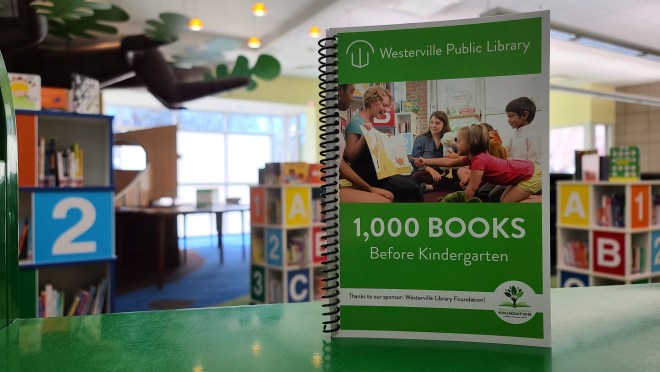
At sign-up, each reader gets their own physical workbook and a pencil to log their reading. I love our 64-page workbook filled with many pages to log your reading, early literacy tips and book recommendations, advertisements for various library services, and more.
Our workbook begins with a page to label your workbook in case it is lost and to track how long the program took you to complete.
The next spread focuses on how the program works and those frequently asked questions we highlighted above.
Moving on to a spread with a reminder to log online if you would like (more on that in Part 2) and the first of two All About Me pages. This page should be filled out at the beginning of the program, with the second, similar page being filled out after you’ve read 1000 Books.
Next come the early literacy spreads! I love how these turned out. Four age ranges are featured: 0-1, 1-2, 2-3, and 3-5. Each spread has an early literacy tip for read, sing, talk, play and write, as well as 12 book recommendations.
Listing books in a printing of this volume (we purchased 1000 of these logbooks at once!) was quite an endeavor. While we still ended up publishing pages filled with many of my favorite books, some of these were round two or round three suggestions. I worked with our collection development team to find books that we could bulk up on copies of now and that we would hopefully still be able to purchase (or would still own) in 3-5 years, since these log books will be sticking around a while.
Next we have lots and lots of book logging pages. Each page contains 25 images. Each image represents one book. Families can color or check off each image for each book read.
Pages marking 100-book intervals have a special spot for a sticker that participants can pick up at the library. Our marketing department designed and printed our stickers in house on label paper:
But what if a family really wants to write down the names of the books they read? There are a few pages to record up to 30 favorite titles in the workbook, and the online system encourages writing out each title.
Wrapping up the workbook, we have our second All About Me page and advertisements for some of our other library programs and services.
What does a day in the life of a post-pandemic children’s librarian look like? I provided a glimpse into an in-the-library day last week, and now I’m going to cover what a work from home day looks like.
Just like library days, each work from home day is a bit different, though I really appreciate the control I have over these days. I have eight hours to move through projects at a speed that I simply can’t accomplish while in the library, where desk hours, in-the-moment projects, and various distractions are guaranteed to pop up throughout the day. As we have more and more days back in the building I’ve been trying to let go of projects because it simply isn’t possible to get done what I’ve been doing at home during multiple 8 hours days of uninterrupted work while working in the physical library and covering desk hours and the like.
I’m also able to set my own schedule. For example I hate waking up early (for me, early means anything before 9 am and definitely anything before 8 am). Something I’ve also always suspected but could never test until the last year–my ideal breakfast/lunch time is actually around 10-10:30 am. And finally, the joy of not having a commute is immeasurable. The lack of traffic since the pandemic began has shrunk my commute time, but being done with work and immediately able to do other things brings joy to my days.
But what do I do all day? I keep busy, that’s for sure. One Tuesday work from home day, coming up!
8:30-8:45 am: Roll out of bed. (Kidding but not. Again, I am not a morning person). Stumble around doing morning things and waking up.
9 am: It’s time to make sure everything is ready for Baby Storytime! When I’m at home, my “studio” is essentially always set up, though I do have to make some height adjustments for Baby Storytime since I have a stuffed animal in my lap. Plus, I always run a tech check–you never know when something will decide to act up. (I use the black desk chair as a storage spot for my book, puppets, and any other physical materials that I’ll need.)
9:30 am: It’s time for Baby Storytime! I’m live on Facebook today with lots of book and animal fun. Storytime runs for about 30 minutes.
10 am: Storytime clean up! Again, when I am at home this is really quick, essentially just dropping anything I need to take back to work into my work bag, and making sure my greeter (who monitored the comments on Facebook) was able to send me the viewing stats for our live program. View this storytime outline here.
10:10-11:10 am: Breakfast/Lunch. This is really nice time on storytime days because this doubles as a post-storytime break.
11:15 am: Zoom meeting with our library’s Equity & Diversity Specialist. I’ve been a part of many sub-committees related to various projects, and during this meeting we reviewed our suggestions for policy and procedure changes that are part of our efforts to create a library-wide de-escalation training (you can’t train staff or expect them to enforce policies the same way when procedures aren’t written down or are vastly different from department-to-department). We also talked about some upcoming Juneteenth program kits that I am excited to be working on with members of the Westerville community.
12 pm: It’s a filming day, and I am filming book talk videos this week. I love our video book talks on YouTube, but this is one of those projects that I know will need to wrap up soon (I rarely have more than an hour at a time off desk or out of a meeting when at work, so finding time to film and edit these is going to become much harder). With that in mind, with the videos I filmed today, I have enough video book talks to schedule one a week through the end of May. I like to think these will continue after May, but realistically my time is going to be pulled elsewhere. I just film all of the snippets today; I’ll leave editing and uploading for tomorrow.
1:30 pm: First comes email (which is always a beast of its own), with a particular focus on confirming dates for the graphic novel virtual author visits funded by a LSTA grant.
2 pm: By around 2 pm, I’m ready to dive into another project that I managed to start at work the day before: storytime planning for the month of April. I have four toddler storytimes next month, and it is much easier for me to plan and coordinate content all at once. And, as we storytime librarians know, planning a storytime takes so much more time than the public (and even some of our non-youth-department coworkers) may think.
For toddler storytime prep, I take a look at what content I have used in the last few months and what new content I would like to mix together. Pre-covid, I mostly presented Baby Storytimes in person. We displayed words to activities on a PowerPoint during the program. To make the planning process simpler, I kept a “master powerpoint” with all the slides I’ve ever used, organized by type of activity, with the last date it was used in the notes field. After a few weeks into the pandemic, I had a feeling we were in this for the long haul, and I started the same process for all of my virtual storytimes too.
This process adds more time to virtual prep, but it also means that I am really ready, content-wise, for in-person programs to return, with more core storytime materials prepared than I have ever had previously. this bank of content is also incredibly useful when planning storytimes. I don’t theme, but instead I follow the same structure each week. Sorting the slides by type of content (early literacy tip, book, song, fingerplay, retelling) lets me easily see what is in my repertoire and when I used it last.
And finally, outlining a month’s worth of programs at once lets me see what I am covering overall. I can look at the kind of early literacy and fine motor skills I am incorporating, but also see what I am missing and figure out a way to add it in. Everything is so carefully selected during our programs–we are trying to meet so many different sets of standards while keeping to a familiar routine and also making sure storytime is fun and engaging. All of that mixed with finding materials we are comfortable and excited to present (and that work virtually!) can sometimes make storytime planning a challenge–it is never quite so simple as grabbing a book and picking a song or two.
This structure also makes it really easy to share my materials with my colleagues when needed–just email the powerpoint file.
4 pm: By 4 pm, storytime prep work is done, and I have an ALSC Education meeting. Lots of conversations about promotion of the ALSC Competencies (which we worked on updating last year) and discussion of past webinars that we have reviewed. This meeting is always fairly quick, and by about 4:30 pm, I am back to library work.
4:30 pm: It’s time for Wizards & Wands planning. This is the project I really wish I had more time to dedicate to while working from home because balancing the rest of my job and an annual event for 3000 people with a $18,000+ budget can be a lot. But, since the pandemic isn’t over, we still just don’t know if there will be an event this fall, so there is only so much work I can do.
However, “only so much work” does not mean “no work”, and even with no clear answers about whether the event will only be a month of decorations or an all-in-one magical evening, there is a lot of prep work that needs to take place to create the level of immersion we are used to. I finalize the agenda for this week’s full committee meeting, update the list of past presenters to include those we contacted and cancelled in 2020, talked to our Decorations Lead about projects she can work on and projects she can bring to the group, booked meeting rooms for the end of September so we have a space to prep our décor before we hang it up at the beginning of the month, and prepare an assignment form with all the tasks delegated to the new Prize Drawings Lead committee role that I will be creating at Friday’s meeting.
I haven’t talked about this program much on the blog–it feels like a challenge just to figure out how to structure a series of blog posts about this event. But maybe someday? In the meantime, catch a glimpse of what this event looked like in 2019 in this video (moving forward, we have made the decision to keep the magic, but remove anything directly related to Harry Potter).
6 pm: Done for the day! As much as I dislike mornings, it feels great to have a full evening to myself (especially when a work from home day follows another work from home day, and I don’t have to go to bed super early because I don’t have to wake up super early).
Work from home days have the benefit of large blocks of time that mean I can concentrate on a project and get it done in one sitting instead of having to return to it in 15-minute chunks of time over multiple days. My time work from home has helped me see the argument for the problem with multitasking–because in-library days are filled with multitasking as we help patrons, answer phones, pull bundles, respond to emails, talk to coworkers, and work on everything else on our list. I’m especially wondering how make-and-take programs will work with full in-building hours–those are ever popular, but for me, all work on those has been regulated to at-home time.
I’ve never been bored during work from home days, that’s for sure. I’ve been a bit jealous of people who have been able to power through their backlog of webinars and professional development. I have been able to watch a decent amount of content over the last year (maybe 1-2 a month), but I have really had to prioritize it. More often than not, a great webinar is added to my running to-do list, and a few months later it drops off the list again because I know I won’t get to it.
What do you work from home days look like? Share in the comments below.
A lot can change in a few months! I last blogged about Virtual Reader’s Advisory and my video book talks in September. Since then, we’ve tried other methods of virtual reader’s advisory, including the Virtual Book Displays I shared a few months back and even a few Virtual Book Talks directly to classrooms.
But the biggest change since any of those previous posts is that–like many of you I imagine–my library is now open to the public! Real displays are once again a regular part of our service, and it feels like our patrons want them more than ever before, with displays quickly being emptied and a few requests last week for more face out picture book options.
However, many people still aren’t coming into the library, so we are continuing to look for ways to virtually promote books. Read on for some information on Overdrive Curated Collections and new video book talks.
OverDrive Curated Collections
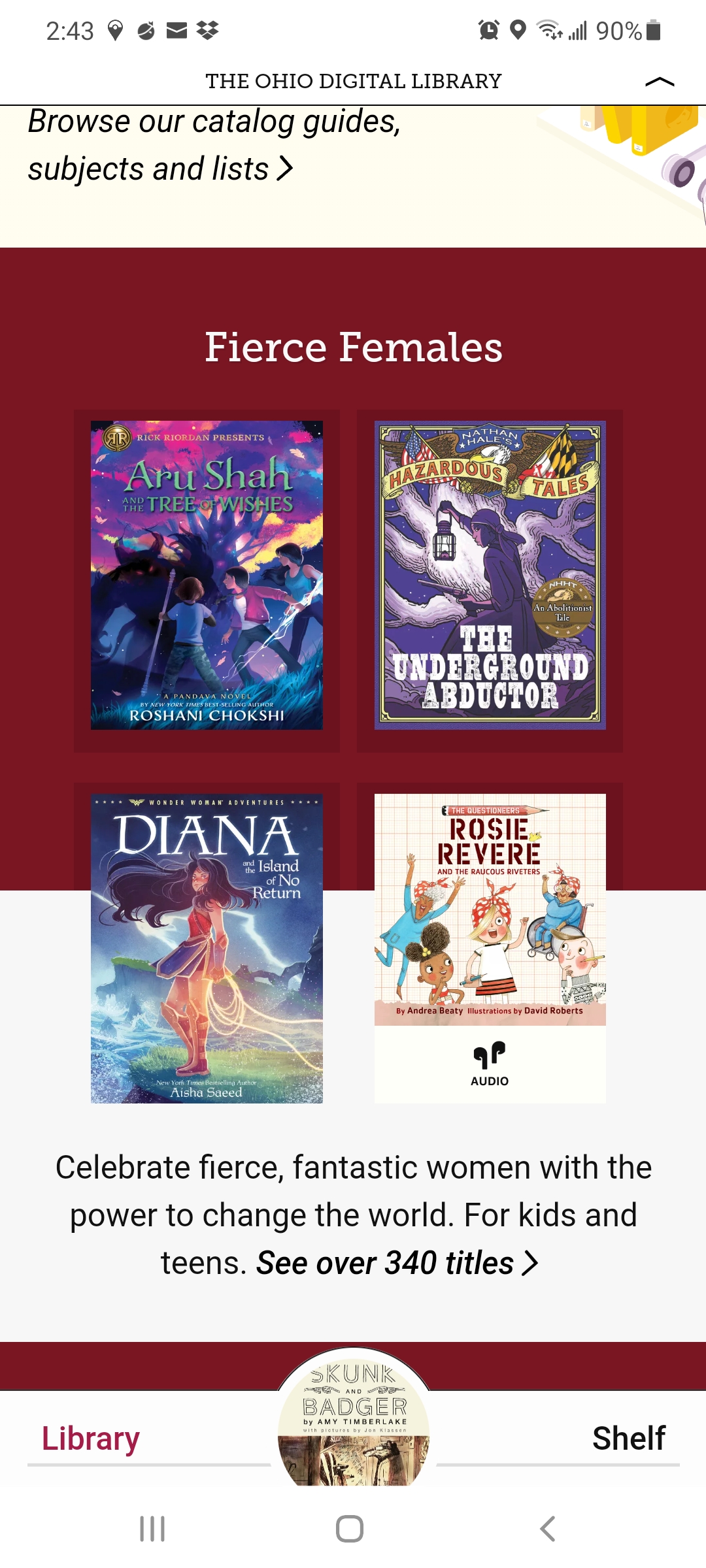
Our OverDrive system (part of the larger Ohio Digital Library collection) lets us create collections of books to highlight on the Libby app and Overdrive website.
The backend looks a little drab, and the process for adding books to the list isn’t my favorite:
To add books to your list, you need to search for them one at a time in Overdrive Marketplace (or search for subject headings and filter).
Adding to the frustration of that system, many kids books, especially picture books, aren’t available as ebooks (or we don’t own them, and since I am not in charge of purchasing, I can’t add them).
But even with those struggles, I had a lot of fun making lists for this service. I use Libby a lot personally, and it feels great to see something I created front and center on a service like this.
From what I can tell, you should be able to see these collections through the links below, even without an account at my library. The exact books you see will be randomized, with available titles showing up first. Check out some of the collections I’ve made:
And of course, video book talks continue on our YouTube channel. I’ve streamlined this process a bit, but these still have a similar vibe to the ones shared in my original video book talk post as well as my virtual reader’s advisory post.
Find some of my newest highlighted titles below (and subscribe to my library’s YouTube channel for at least one additional video book talk each week!).
13th Street: Battle of the Bad Breath Bats by David Bowles
American as Paneer Pie by Supriya Kelkar
Becoming Muhammad Ali by Kwame Alexander and James Patterson
Before the Ever After by Jacqueline Woodson
Best Babysitters Ever by Caroline Cala
The Best of Iggy by Annie Barrows
Black Brother, Black Brother by Jewell Parker Rhodes
Count Me In by Varsha Bajaj
Craftily Ever After by Martha Maker
Dave the Unicorn by Pip Bird
Desmond Cole Ghost Patrol by Andres Miedoso
Diana and the Island of No Return by Aisha Saeed
Dramatic Life of Azaleah Lane by Nikki Shannon Smith
Farah Rocks Summer Break by Susan Muaddi Darraj
I Can Make This Promise by Christine Day
I’ll Be the One by Lyla Lee
Keep It Together Keiko Carter by Debbie Michiko Florence
King and the Dragonflies by Kacen Callender
Klawde: Evil Alien Warlord Cat by Johnny Marciano
The Land of Cranes by Aida Salazar
The Little Mermaid by Jerry Pinkney
Locker 37: The Rewindable Clock by Aaron Starmer
Love Sugar Magic: A Dash of Trouble by Anna Meriano
Magnificent Makers: How to Test a Friendship by Theanne Griffith
Max Meow: Cat Crusader by John Gallagher
Measuring Up by Lily Lamotte
Mellybean and the Giant Monster by Mike White
Mia Mayhem is a Superhero! by Kara West
Not Your All-American Girl by Wendy Shang and Madelyn Rosenberg
The Only Black Girls in Town by Brandy Colbert
Paola Santiago and the River of Tears by Tehlor Kay Meija
Pie in the Sky by Remy Lai
Sherlock Bones and the Natural History Museum by Renee Treml
Shirley & Jamila Save Their Summer by Gillian Goerz
Sparkleton: The Magic Day by Calliope Glass
Spirit Hunters by Ellen Oh
The Street Beneath My Feet by Charlotte Guillain
A Thousand Questions by Saadia Faruqi
Twins by Varian Johnson and Shannon Wright
Ty’s Travels: Zip, Zoom by Kelly Starling Lyons
Witches of Brooklyn by Sophie Escabasse
Zenobia July by Lisa Bunker
Zoey & Sassafras: Dragons & Marshmallows by Asia Citro